Breezy_Pete
Sponsor
-
Joined
-
Last visited
Everything posted by Breezy_Pete
-
-
Check fuse 35 (10 Amp) for loosenesss or corrosion on the terminals. It supplies the injectors.
-
What engine code and year? Or VIN if easier.
-
Relevant relays are probably in positions 13 (engine ECU relay), and 14a (fuel pump), both on the bottom row of the relay panel.
-
Unlikely, PM me your VIN if you'd like me to see if I can find stuff applicable to your gearbox.
-
A very good point.
-
Open circuit voltage isn't the best measurement; you really need to see what the voltage dips to when a button is pressed.
-
Adding some sound insulation around that control unit is probably the best approach to minimising the annoyance.
-
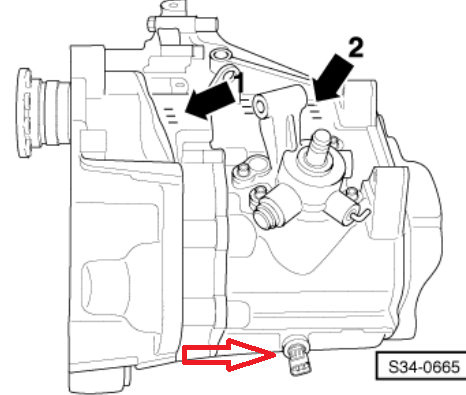
Red arrow:
-
Wiring breakage adjacent to the connector plug is another strong possibility @GrahamM. Lowish on front face of gearbox.
-
Don't know, look for google images corresponding to those exact part numbers and compare with what you see in the car. Diagrams are often a bit generic on ETKA. Those data are from partslink24, a subscription site. Approximately the same info can be found here, minus the VIN filtering: Car Parts Catalog - LLLParts Your car was built 27/06/2007 BTW.
-
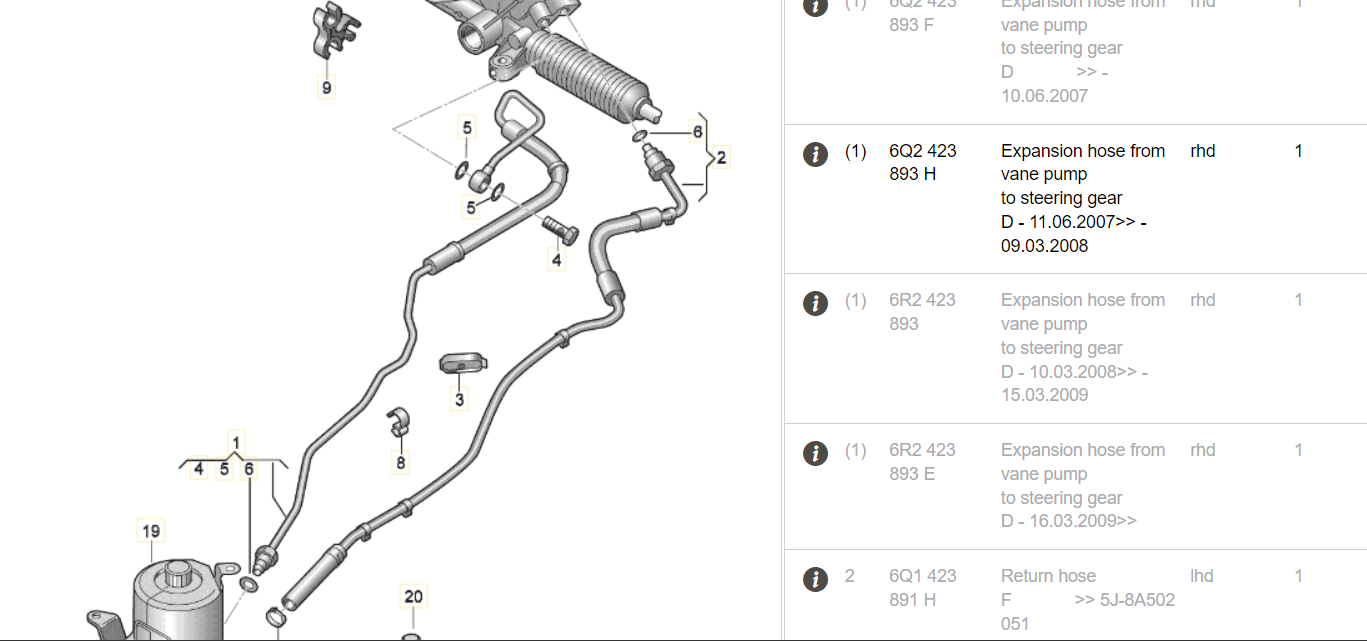
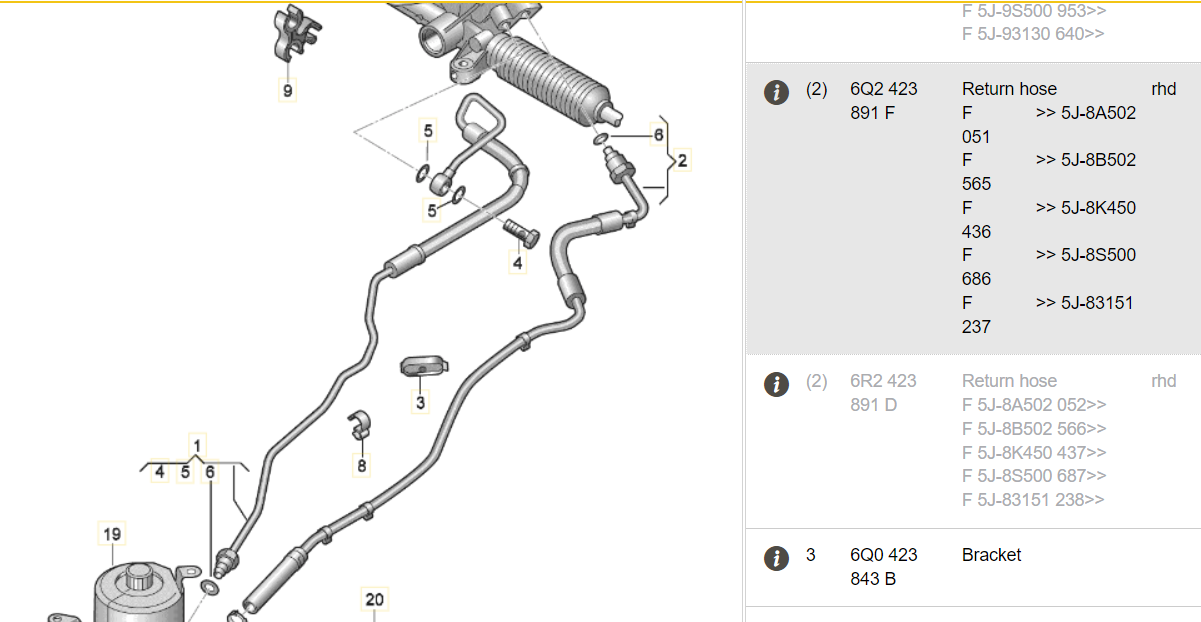
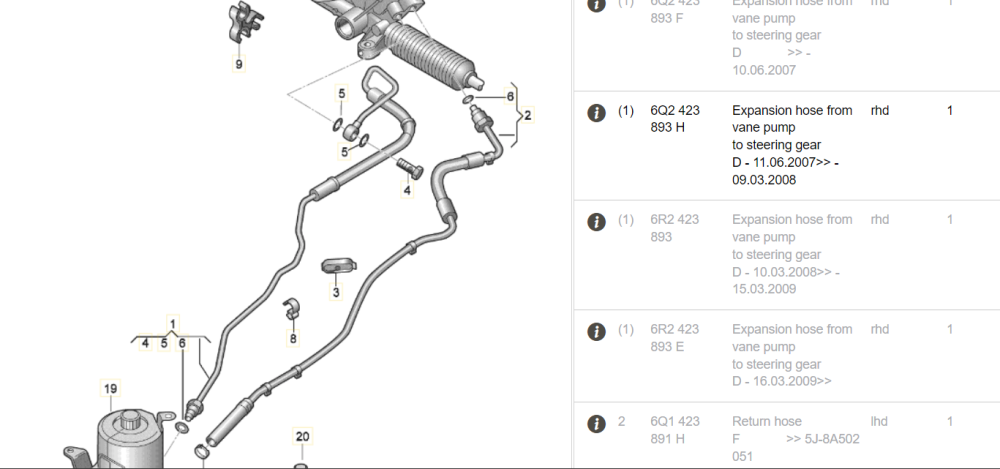
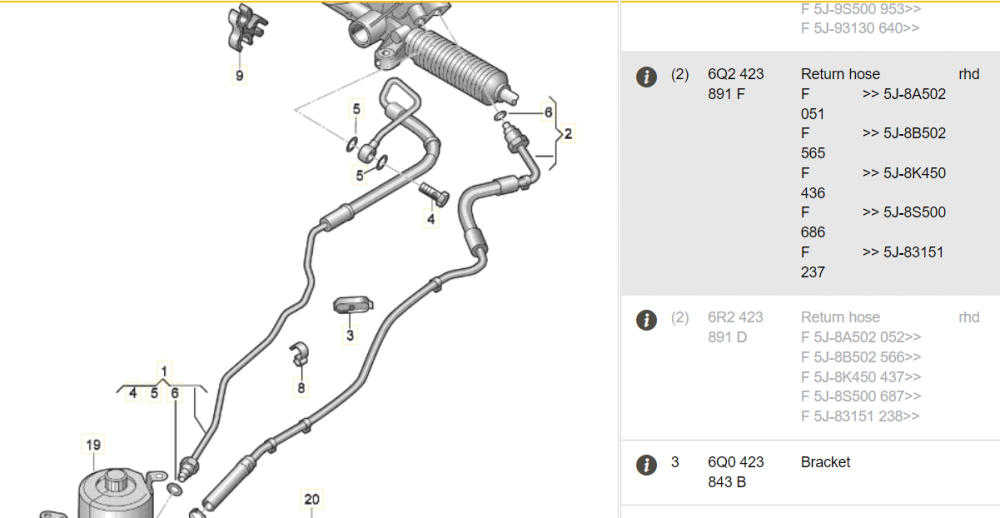
Neither hose available from Skoda any more. Genuine prices before they were dropped were amazing: £273 + VAT and £181 + VAT. Watch out for aftermarket ones with claimed equivalence to similar part numbers on ebay etc, but with 6Q1 instead of 6Q2 at the start, they are for LHD set-ups and presumably won't fit. Not sure if the 6R2...part numbers shown below each of these and applicable to later built cars can be made to work on your set-up, but they're not shown as supersessions for your hoses.
-
Have a good look at the thermoswitch too, a few inches above bottom hose connection. They like to leak too, but can be fixed by just tightening a little.
-
Looks like a spurious code to me. No N279 in the circuits of a 2007 BLT engined Fabia. In fact, I don't think any mk1 Fabia has such a blocking valve. So I'll go with no, that's not why you're losing coolant.
-
Not sure if there's anything useful in the official workshop manual, but maybe worth a look. MK1 Fabia workshop manuals - SKODA Fabia - BRISKODA Eleventh file in list. Engine mechanicals 1.9-74kW Oil leakage may be a symptom of underlying faults with the crankcase ventilation system, causing excess pressure.
-
MK1 Fabia workshop manuals - SKODA Fabia - BRISKODA Click 'Download this file' then the second pdf link in the list.
-
That's not a valid VIN for a mk1 Fabia. Look through the windscreen from outside just by passenger side wiper, it's visible there.
-
Depends on refrigerant pressure when A/C is on. In cold ambient temps this will not necessarily approach the threshold for fan activity.
-
Coolant temperature is usually sensed close to the radiator outlet in the context of fan activation. On cars with traditional radiator-mounted thermoswitches the first (low) speed operation tends to be at about 95/96C at that point. For the coolant temperature to be that high at the outlet, it will obviously need to be even hotter at the radiator inlet or engine head. Not sure if your car has this type of thermoswitch, or a sensor in an adjacent hose. Probably the latter.
-
Part numbers can be found here: https://www.lllparts.co.uk/catalogs/skoda/CZ
-
Generally it's a single pump that does front or rear washers depending on polarity of power to it.
-
Ours (1.2 petrol) is on 199k in a few miles, but the engine currently in it has done a lot fewer miles.
-
HTP has a timing chain and that's expensive to change. You'd want to be very sure it is causing a significant problem before spending several hundred on that. Auxiliary belt can be inspected fairly easily for obvious major degradation, but quite cheap and easy to change if it does look very rough. Photograph the belt path first though, easy to put new one on wrong if you haven't got a reference to look at.
-
It's quite likely to be burned out relay contacts within the BCM, I think. It may be possible to replace this relay if you can get into the unit, identify the relay, buy a replacement, and have the necessary desoldering/soldering equipment and skills.
-
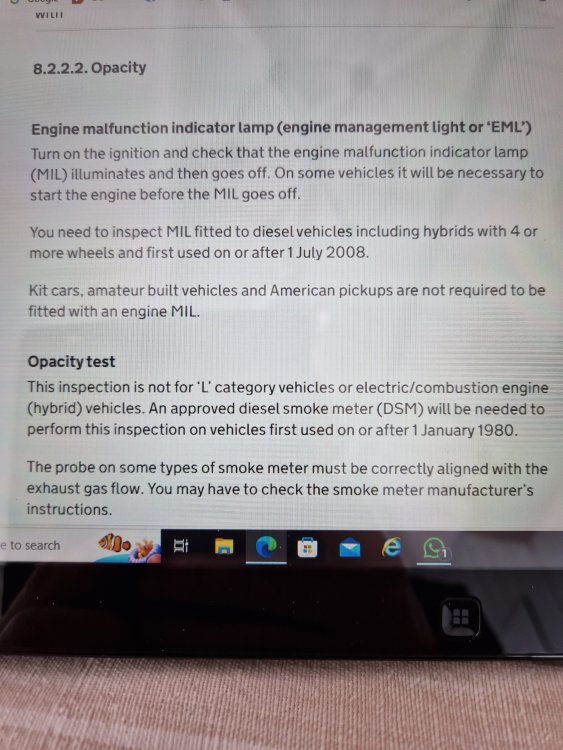
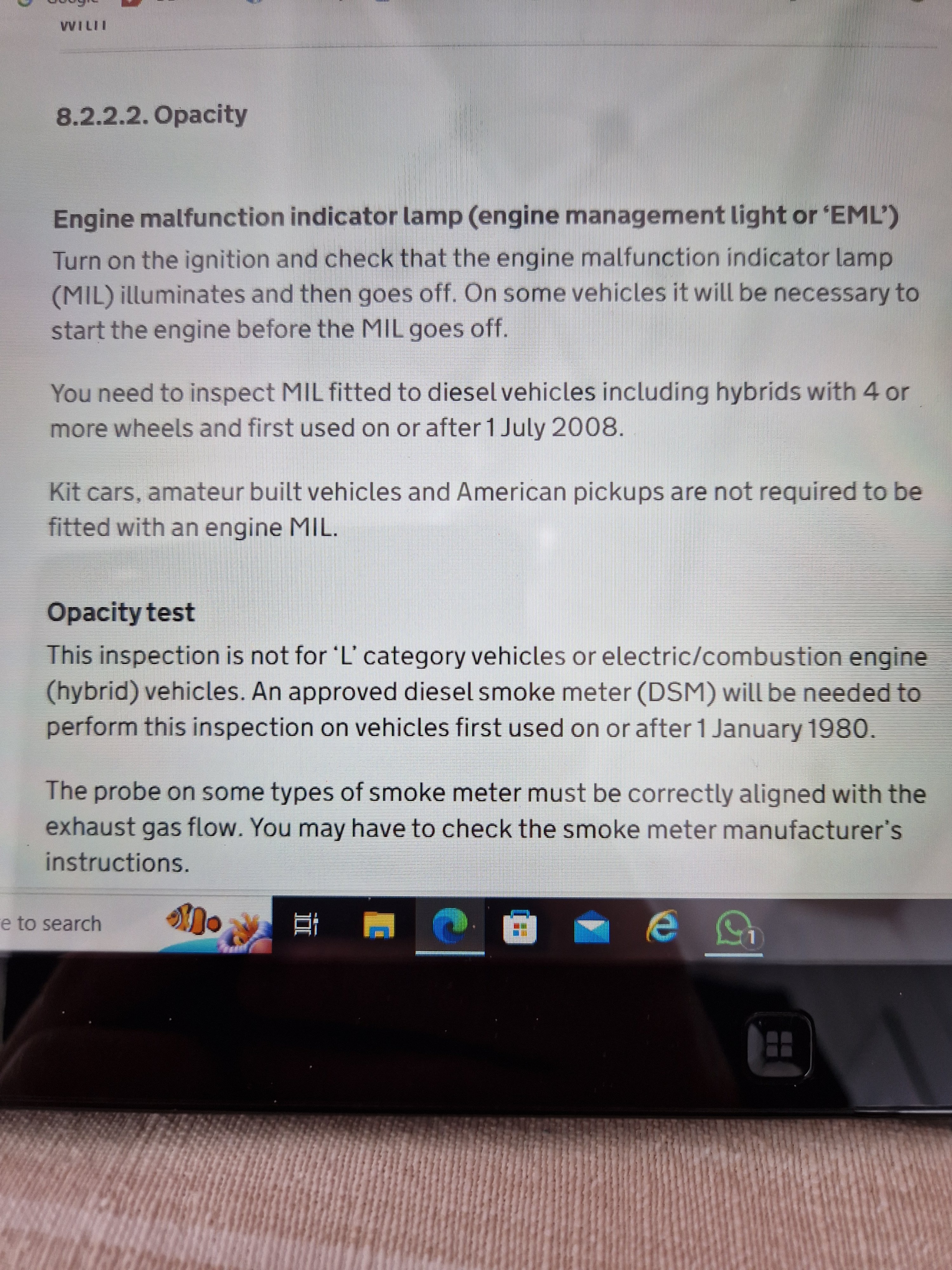
Yep, not til 1st July 2008, see pic below: Try to find a polite way of telling the tester to read his manual.