
nta16
FREEDOMLite
-
Joined
-
Last visited
Everything posted by nta16
-
Swapping the two front tyres to rear should be fine as you'll make allowances for any differences during your testing. Perhaps if you could make a recording of the sound. Was the noise before or after the change of callipers, pads, discs and bearings (perhaps something could have been disturbed or parts quality).
-
Have a look at your Driver's Handbook / Owner's Manual, you can know more about your car than many long term owners by reading it and referring to it. If you've not got your paper printed copy you can download a pdf copy from the following link. - https://manual.skoda-auto.com/004/en-com/Models
-
Yes it might be or you might just be shooting the messenger. The error codes point you in the right direction for the start of your diagnostics, they're not always the final answer. If you do need a new sensor research in the Octavia forum with VRS owners and other that know how specific the the make and model of sensor needs to be. Cheap sensors can often be a total waste of time, effort and money and be unreliable and/or short-lived. "What are the Possible Causes of the P2196 VOLKSWAGEN Code? Faulty Front Heated Oxygen Sensor Bank 1 Front Heated Oxygen Sensor Bank 1 harness is open or shorted Front Heated Oxygen Sensor Bank 1 circuit poor electrical connection Inappropriate fuel pressure Faulty fuel injectors Intake air leaks may be faulty Vacuums leaks - [a cheap easy(?) thing to look for] "How to Fix the P2196 VOLKSWAGEN Code? Start by checking the "Possible Causes" listed above. Visually inspect the related wiring harness and connectors. Check for damaged components [hoses/pipes disconnected or leaking] and look for broken, bent, pushed out, or corroded connector's pins [clean connectors with electrical contact cleaner]". https://www.700r4transmissionhq.com/p2196-volkswagen-passat/
-
A flat battery will hinder progress on solving and resolving starting and other electrical issues, a good battery in a good state of charge with all connections clean and secure will help progress on solving and resolving starting and other electrical issues. Do bear in mind if the battery going flat isn't a sudden thing but a longer term problem then if the battery or its charging system is weak it makes the other work harder, sometimes wearing the other down so the rectification or replacement of one can still leave the other weakened.
-
Even a 'new' or new battery can be depleted. I can think of a good number of times I've been told "the battery (or its connections) is good" and they weren't, especially when it's a spare battery or off another vehicle. The hot weather now won't be particularly good for batteries (or charging systems) sewing the seeds of battery replacements this autumn and winter. If a battery or its charging system is weak it makes the other work harder, sometimes wearing it down so the replacement or rectification of one still leaves the other weakened.
-
Well summer seems to be sorted at least. Well done.
-
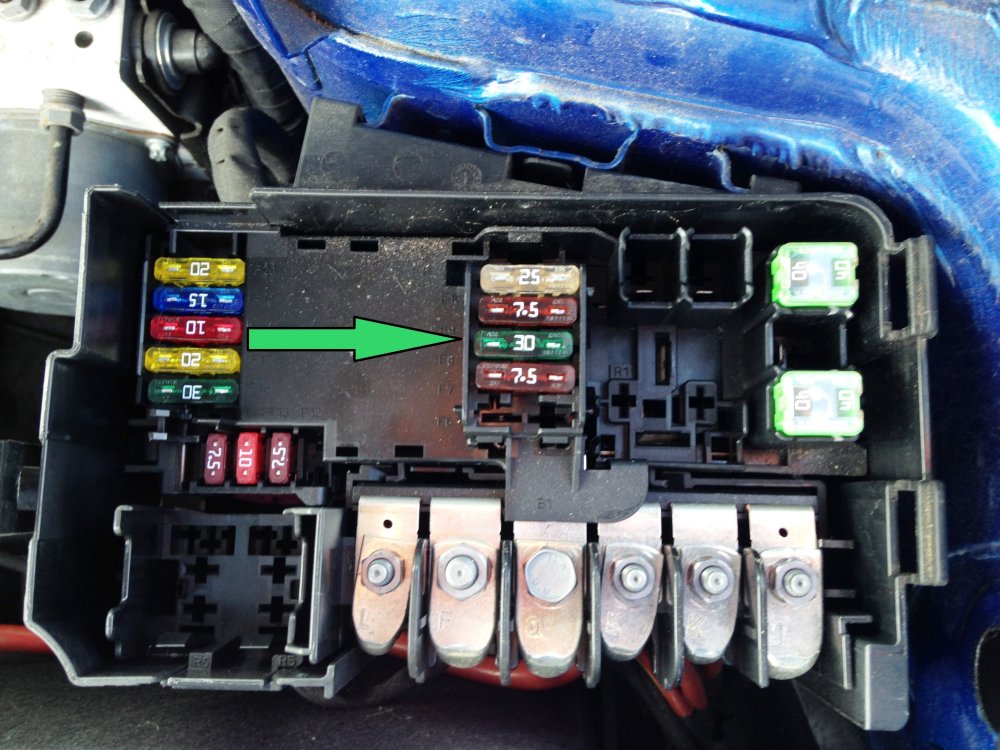
A word of warning about the under bonnet fuse box diagram, in the copy of the Owner's Manual we have and as John has put up, in my wife's 2015 right hand drive model at least the diagram was different to what was in her car so check the fuse is for what the Manual says it. I am a big fan of reading and referring to Driver's Handbook /Owners Manual but they can have error and omissions and translation errors perhaps. As an example the green arrow is pointing at the fuse for the windscreen wipers in my wife's car.
-
Probably won't matter to hetty1 if the car is for mainly short journey town use but when I changed my wife's 2105 Fabia Mk3 tyre pressures from "normal" to Eco, with the four Nexen tyres fitted at least, the handling and ride was noticeably not as good - but the standard Fabia isn't exactly a sportscar anyway. I think the Eco pressure, in the appropriate conditions, can add a little more interest to the drive on more twisty roads. As I've seen a few Aussie owners of other cars put how they run tyres at high pressures so that may be to do with the different conditions to the UK and also possibly different tyre compounds for the region - but I don't know if the vehicle manufacturers state higher pressures there.
-
I've just posted on Fabia Mk3, my wife's 2015 Fabia Mk3 had Avon ZT7s fitted to the rear 2 years and 12k-miles ago, other than wearing quicker than the more agricultural Nexen NBlue HD Plus I'm not discouraged from putting two, or four, more on when next required. Personally I take professional tyre reviews and tyre label grading (old or new) with a pinch of salt and personal reviews have so many variables. If your car sits around a lot with little mileage then cheap hardwearing (tread) tyres might craze and crack well before the tread starts to really wear. - https://www.goodyear.eu/en_gb/consumer/learn/eu-tire-label-explained.html With a heavy (as most modern cars are) modern car with 170hp tyres are particularly important, more weight and momentum, the 4x4 is little without the appropriate tyres in good condition. Even with the driver's brain and all the vehicles computer programs it's still the tyres that contact the road (or grass, hedge, field).
-
Try going to -
-
The Eco setting is a Skoda recommended pressure so it isn't too high. Despite the heat, the tarmac and concrete are hot, I've taken some measurements with my simple pen style gauge (and wonky eyes) to help you decide. I set the tyres at Eco setting. I measured at just off lines of TWI (tread wear indicator bars) to be consistent and took three measurements on each tyre, middle and both sides grooves. Front tyres are four and a half years old, 30,000 miles, Nexen Nblue HD Plus - distress purchases as one of the original Nexen (NBlue?) got a hole in it and I like to swap in at least pairs - IIRC these would have been on the rear until 2 years ago. Offside front - 4 - 4 - 4 Nearside front - 4 - 4 - 4 Rear tyres are two years and 12,000 miles, Avon ZT7. Offside rear - 5+ - 5++ - 5+ Nearside rear - 5+ - 5++ - 5+ Now as you can see there's a surprising anomaly, the outsides appear to have worn very slightly more than the middle, I checked twice to be sure, my gauge only shows numbers and the difference was small, perhaps the outers tread are patterned or worn, a four wheel alignment was done when these tyres were fitted but that means nothing given our Third World roads. (but at least the top bankers didn't loose their pensions or bonuses). So if anything this suggests I may need a higher pressure to those rear tyres. The Avon ZT7 have 'Avon ZT7' raised in the middle grove and very thin slightly raised ribs in the grooves, I don't know what these are for unless it's the noise reduction, they certainly look a classier tyre than the Nexen but obviously more for grip than wear than the Nexen. HTH.
-
Reverse gear is, er, geared, more than the forward gears I think Ken put it was a something idle-wotsit (rather anti-stall) with letting it chug along in the (forward) gears.
-
I'm not sure that changing the air filter might resolve this issue but having a reasonably clean air filter and all the air and fuel systems and their sensors clean will help. If there's and air leak, or the computer thinks or is incorrectly told things are lean it may compensate with going rich, which the new cat won't like or MoT. If the whole car is in reasonable running condition then the occasional Italian tune-up can help. Doing it just before an MoT can perhaps help especially if the car doesn't then sit for ages before the MoT gets done.
-
As rootoot has put. You've got a different engine now so you need to get used to it and unless you're driving a different vehicle don't worry about the differences just get used to them. We've had 3-cylinder engine cars and not just used for pottering around town, with turbos and one with out, only the non-turbo was a 1 litre the others a lot less cubic capacities. By what I've seen on here they were probably more refined engines, and were in slightly lighter cars, but I'd not worry about a 3-cylinder engine just perhaps more careful to keep up with timely servicing, maintenance and repairs. I think you're wise to go for annual oil & filter changes and I'd go for good quality oil (but then I always do) but you'll get what the dealer/garage has regardless. Someone else here reckoned it was wasn't a good idea to let the car pull itself along on its computer settings with your foot off the accelerator as it could cause more wear to clutch/ flywheels - but I don't know. Inflating the tyres to their eco setting shouldn't give extra wear, it's not happened to the tyres on my wife's Fabia but does give a noticeable decrease in rolling resistance so presumably some effect to mpg and the emissions (muck/crud/crap/bits of 'rubber) that comes of the over large and wide too low profile tyres that fashion dictates are on modern cars. Some say all tyres should be inflated well over car manufacturers recommendations, I think you can experiment a bit with different tyres but not stray too far from what the vehicle manufacturer recommends.
-
It might just be the photo but it doesn't look that clean to me, try holding it up to today's bright sky and see how much you can see through it, you could try a tap and blow clean or if you compare it with a new clean filter you may decide to fit the new clean filter instead.
-
Full and proper servicing (rather than the very minimum 'stamp in the book' type) and condition of the car. Even allowing for the lack of use during Covid restrictions I'm not sure you'll see too many more with just 2k-miles per year on them as those tope of owners tend to change to a new car at 1-3 years or keep them a very long time. Have look for high mileage Toyotas and Hondas and if you can wait into August and September there might be even more cars around at better prices.
-
There are scanners and scanners - but as gazza27's doesn't start it might not be battery, reminds me forgot to ask if the starter/engine turns. My questions were aim at gazza27 (perhaps you missed me quoting him). And I too had to smile at battery shop coding it wrong.
-
Did you put the battery on a fast, or booster, charger? Have you checked both battery post connections are tight? ETA: Does the starter/engine turn? Any warning messages or lights? Have you checked for error codes with a scanner?
-
Short answer - yes I would buy it, but it's not my first car and I'm used to putting a bit more effort into a car than the average owner - I've already made repeated mistakes with cars. I'd expect the car to be fully serviced as a 6 year-old car rather than as a car at 14,000 miles. Long answer - whilst the general principals are the same the USA the UK is very different. Personally I'd sooner see 35k-miles for low mileage but then it depends so much on the frequency and type of mileage. No one here can give a definitive answer, only generalisations, we know less about the actual car than you. Potentially if all the servicing and maintenance was done well and in a timely fashion it could be a very good car (subject to condition). The main thing is to get the car moving and you'll find any niggles and hopefully drive through them and sort and improve them. If the seals are dry they'll get lubricated by good quality oil with use of the vehicle otherwise you'll see leaks. If the car isn't used to being driven much then you drive it progressively for it to get it used to it building up. Never take anything recorded without checking it, if it has the brake fluid was changed check it with your eyes and a refractor if necessary, look at the date stamp on the tyres, the tread wear, depth and condition including inner and outer walls - don't believe something just because it's on a computer, anyone can type anything into records (you'll learn). The advice is, it could be a very good deal but don't overpay - but it doesn't mean it's all sweetness and light and a bit more effort might not be required, I have a piece of string in my hand - what colour is it?
-
MrZ generally plastics and rubbers stand up pretty well, are you worried about internal plastics and rubbers of the engine bay, cabin, boot, exterior? I know some neighbours with 17-20+ year old cars that get little more than an annual service and occasional clean that sit outside 365/6 days a year and they remain fine. One is used a bit and shows sighs of it's age but nothing bad still very functional. The other is 17 years old just reached 27k-miles, all very original, I've cleaned/polished it a few times over the last 3-4 years and gave it a thorough clean/ polish inside and out (engine bay, boot, interior, under wheel arches) for an MoT resubmit and the car looked good, other than tyres and windscreen wipers all AFAIK original plastics and rubber. The headlining had sagged but that was cut and glued back up using an added centre strip Now those are plastics and rubbers are from 17-20+ years ago not 6 years so not necessarily the same but I do next to nothing on my wife's car, it too sits outside 365/6 days a year and the plastics and rubbers all seem to be fine but the car is used every day with very few exceptions. The plastics and rubbers that should concern you are tyres, brake/fuel(?) lines, wipers, lights -- which reminds me the front (head) light units do seem to craze/scratch up a bit some I've bought so stuff to try to stop them getting much worse too quickly, but in 6 years I've not really looked after the car like I would have in the past, or should have now as I get ****ed-off with doing my own car. As has been put you need to find the (proven) history as much as you can of the car and also evaluate the condition it's in now. You can look up mileage from previous Mots and the garage will be able to give you recorded work done on the car. If you're at a new car showroom, and/or there are various ages of Fabia around you can compare the condition of the rubbers and plastics on those cars to the one you are looking to buy. What are your particular concerns about the rubbers and plastics?
-
Good news. Do be careful about not getting anything on the seatbelt webbing, cover it if spraying nearby. Yes or put an arrow on the diagram from the previous post. I doubt if the spraying has cured it but it has located the area and relived it for now. It might ne that a bolt is loose and needs nipping up but I'd hope not with anything to do with seatbelts or it might be like a lot of car servicing, maintenance and repairs in that it just boils down to clean and lubricate. GT85 does both. I keep cleaned used toothbrushes for brushing out muck, grit and debris, first dry with perhaps a vacuum nozzle near to collect the crud and then depending on what, where and what is needed use the toothbrush with the GT85 or just spray with GT85 and work it in by repeatedly moving whatever is needed. For lubricating GT85 is obviously thin and sometimes a more heavy duty lubricant is need for longevity but even then GT85 can be good for an initial use. If you're getting a lot of rattles check that your tyres are all correctly inflated and that the potholes haven't damaged your wheels or suspension. The fashion on modern cars is to have oversized wheels and wide very low profile tyres so these transmit more road noise and vibration which is opposite to what is needed after the deterioration and lack of upkeep from the previous economic downturn.
-
I just copied and pasted the thread title and copied also repeated the error. If you want more I can give you more, and if you want to play I can give you even more. 😁
-
Forgot to cover this. The condition of the car should tell you a bit but it will depend on how much the seller knows (or wants to tell you). Was it kept in garage or outside, but then a poor quality garage can be worse for rust. If it was kept outside always parked in exactly the same position their might be more rust one side or area than others, perhaps even fading of paint or internal fabrics but hopefully not or not too much at this age of car. If it's outside it might have been always kept fully locked with the windows up so days like today the internal temperatures would be high but these cars are test to take such but it'll certainly get more sever and extreme heat/cold, wind/rain/sleet/ice/snow cycles parked outside than in a heated and dehumidified garage. Personally I'd want it fully serviced by time interval on all items before I bought it so that I could as soon as possible use it the way I wanted. If you've not already done so you can research the common problems with the model generally but also specifically to what is fitted to yours, the engine, gearbox, toys inside, put the details here and others will know. Even though I've known for decades that "German engineering quality" isn't all it's cracked up to be (Merc, BMW, VW (Skoda)) and allowing for the price difference to generally more robust and reliable marques like Toyota and Honda I was surprised that my wife's car needed the front dampers and brakes replacing at 41k-miles, 6 years - but we don't know the history of use for the car's first 10k-miles. I've changed the gearbox oil and coolant but you'll never get the dealership to and many owners say it's not necessary. Which brings me on to the often debated cambelt change, if relevant to your model, it's in the schedule for 5 years so you want it by the Dealership if the car's supposed to be fully serviced, plus anything else relevant in the service schedule (these won't/might not(?) include driver's maintenance items that some bother with and others don't. Vehicle/driving priorities are brakes, steering, suspension (all three include tyres), safety electrics (lights, horn, wipers, blower, etc.), and glass in windows and mirrors., then you can look at comfort and toys. They will sell the car a a low-mileage premium, whether to you or someone else, so if you buy the car you want full valve for this (justifiable or not) premium in that the car is premium by being as fully sorted as you can have it. You already better understand the real value of a low mileage car than many. To the salesperson a closed sale is worth negotiating with you and whoever is in charge their side as they will try to get more out of you from add-ons especially financials.
-
Hi, welcome, first car only 6 years old well done to you. You are quite right about low mileage not being good in many respects. What you need to look at is what work it's had done in that time and that the work has been done on time. Servicing often is just an engine oil & filter change and "free visual check", the engine as you probably know not one of the priority component or system on a car. If you're buying from a Skoda Approved Dealer I'd expect them to at least have completed the service schedule (by time rather than mileage) but that doesn't cover all that might be needed - generally they do as little as possible not more on a car they're selling. 2,000 miles a year also depends on was it one journey a year or 2,000, short journeys are good for the engine, proportionately more wear on other components too and not good for battery charge. If you've not already done so you need to test drive a few other similar 2016 Fabias to see how well they should drive or how well the one one want to buy drives in comparison. Check the operation of the brakes and ask how worn they are and check the as much as you can and know how - low mileage cars can be driven by people who are not good drivers and easy on the car's mechanics. 12 months good use should turn up many niggles or issues but how many you can get covered under the warranty is a very different matter. First two things that come to my mind are tyres and battery. Regardless of the thread on the tyres they're 6 years old and might not have had regular or far enough use to keep them in good condition - but the dealerships didn't use to change them if they had 3mm or more tread on them. I would still measure them in case of uneven wear and have a good look at the wheels at the same time for knocks and grazes. You might not get anywhere with the tyres but it can be mentioned as an accumulator to other things you might find. If the car battery hasn't already been changed then see if you can get that included, see later for how important the battery is, particularly on a VW. One of the best things you can do is get a copy of the Driver's Handbook (Owner's Manual) and read it before buying the car and then you'll know what's on the car and it can do and what's not and you'll probably know more than the salesman, and if you refer to it you'll know more than many long term owners. PDF copies here. - https://manual.skoda-auto.com/004/en-com/Models You can also check for any Recalls here. - https://www.skoda-auto.com/services/recall-actions And Updates here. - https://updateportal.skoda-auto.com/ Good luck.
-
Put a spanner on just to make sure they're nipped up but don't overtighten. That looks a lot for just residue. If you have another spanner of the same size try that as spanners do vary in fit and feel. As already put if in doubt replace with new. I always put a bit if red grease around the nipple threads after loosening to act as an air and muck barrier.