Breezy_Pete
Sponsor
-
Joined
-
Last visited
Everything posted by Breezy_Pete
-
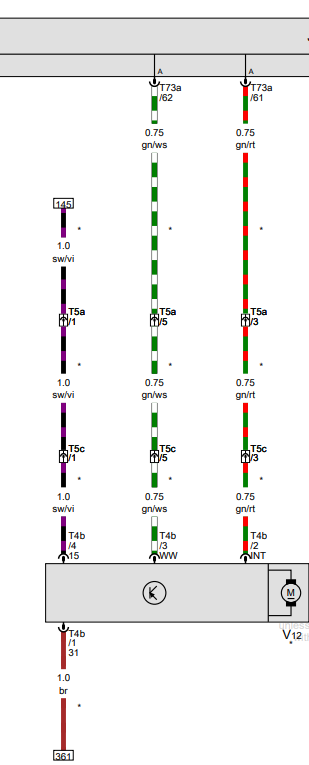
Just had a thought. I've made an edit early in the above post cos I made an assumption that could be invalid. Please confirm/deny that the wire you measured at 14V was so coloured.
-
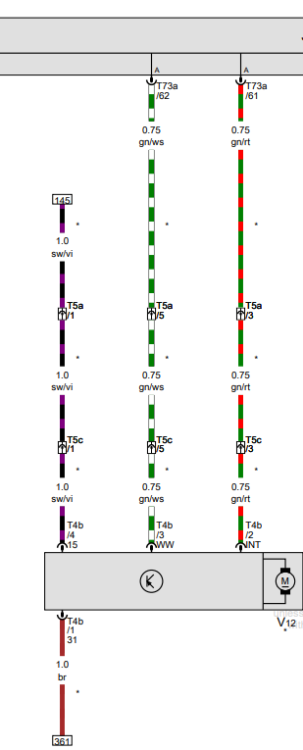
The wiring looks like this, where the black/violet is the one you've measured 14V on (please confirm?). The brown is an earth. The WW and INT are the wires that select Wash/Wipe or Intermittent wiper operation depending on request from driver via stalk and BCM. I don't know as fact, having never measured, but owing to the fact that on some/many earlier models these two wires are parallel-connected to the washer motor at the screenwash reservoir, I recently guessed at the following command logic: WW=12V, INT=0V gives a wash of rear screen for as long as stalk held, followed by a pre-programmed number of wipes. WW=12V, INT=12V gives intermittent wiper function until stalk control cancelled. If I'm right this suggests that one or more of the WW /INT/Earth connections isn't intact, or the BCM isn't receiving the stalk inputs.
-
What year is the car please?
-
Please ask your mechanic to tell you what fault code numbers the car has logged, and then tell us.
-
Don't know locations, sorry. Try looking at ebay listing photos of cxxb engines, if there are any.
-
If you can still edit it (three dots on right of post), change it to a . or 'duplicate, deleted'.
-
Probably something like this: https://www.ebay.co.uk/itm/254302964886 Lots of other thicknesses available.
-
Green is low pressure 0.3-0.6 bar 04L 919 081 Brown is higher pressure 2.5-3.2 bar 04L 919 081 B Another nice illustration of how the letter suffix isn't just a 'revision level'. Can be a functionally different part, and often is.
-
See if the attached helps. The rectangular boxes point you to the 'current path' number where the wire continues. These 'current path' numbers are the ones along the bottom of each page. CFD explanations.pdf
-
It's what came up for your VIN.
-
06J 103 226 A by the looks of it.
-
I'll send you a message with an email address.
-
Message me your VIN and which corner of the car needs sensor, and I'll tell you the correct part number. Tell me the complete exact part number of what has been fitted too.
-
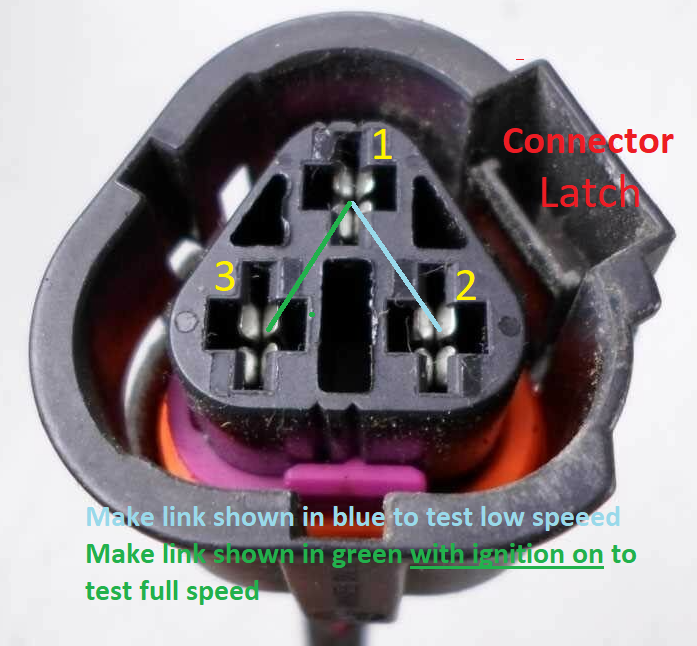
Try the radiator fan test first, very common fault on VW group cars of this age, and will lead to higher temps in the conditions you describe. Any old bit of wire will do for linking, the currents through these connections only power relay coils on A/C equipped cars, not the fans themselves. Note that ignition needs to be on to test full speed function.
-
Test the radiator fans to ensure that the low speed function is operable. Do this by linking pins of the radiator thermoswitch connector. Pinout details can be provided if non-obvious. Does the car have A/C or not?
-
First two results here show you what genuine ones of the correct part number look like. Prices seem OK too. 6Q0698151D for sale | eBay
-
Looks like you do have standard (288) brakes I think, and GSF have duff info in their system.
-
Cool, GSF part number of what you've been given would be handy too.
-
You may have non-standard front discs/pads fitted, the car's new to you right?
-
My mistake, I thought you said discs were wrong size, but I had misread.
-
What size did they give you?
-
Well I've said everything I feel is useful here, byeeee.
-
Might not matter to you, but it does to me. Each to their own but I favour facts over lots of words.
-
1 and 3 are on the current approved list, 2 isn't.
-
Did you mean to ask me that? The list I'm referring to is the current 504/507 pdf on erWin, no mention of US that I can see?