




Breezy_Pete
Sponsor
-
Joined
-
Last visited
Everything posted by Breezy_Pete
-
What's the VIN?
-
Hehe, just scrolled back up to check what I wrote and noticed an appropriate/comedy typo, still visible in your quoting of my post. "Dearer" instead of "dealer" 😆
-
You have a message.
-
I didn't say there was a red engine management light. Wrong side of bed?
-
Is there not a bolt going into gearbox that has a stud sticking out of its head?
-
Those foam bits have an important function, not just to prevent debris. Those plus the rubber seal across the top of the scuttle are there to prevent any fumes from the engine bay going directly into the cabin air intake. Of course, there shouldn't normally be any such fumes, but an exhaust leak etc could be quite dangerous to the car's occupants if that could pass easily through into the cabin.
-
Not standard.
-
No.
-
You could, but as I said above, if the issue is the valve leaking when closed, that will make no difference. It would be a good idea to disconnect it while doing blanking experiments though. Or to do just disco first to see if that alone helps, yes.
-
Yes of course, but that would be heavily dependent on what you consider a reasonable lifetime for a car. Some wouldn't think beyond ten years, some would think 100000 miles is the beginning of the end. Others like me are happy driving around in a twenty year old car with 170k on it. How long do you intend having the car?
-
-
Did you spot my second sentence above?
-
Whole new can. They may have deliberately scratched the replacement though, as revenge for lack of trust.
-
Only thing to consider is that a solar panel, unless with an additional controller of some sort, will not be able to stop charging if/when the battery is full. An intelligent charger will switch off when it detects fullness, in contrast. A low power panel, say 10W or less, is unlikely to do any harm (especially at this time of year) in my opinion, but AGM/EFB batteries in recent start/stop-equipped cars are deliberately kept shy of fully charged by the car's charging control system. Some/most people buy the claim that this is to allow headroom for regenerative charging during braking/overrun, but I think it may be more to do with protecting the battery from overcharge/overheat situations. In a static solar charging situation the battery and engine bay temperature is going to be nice and low though.
-
Read your owners manual. I think historically at least, a red warning light, or a flashing yellow/amber one indicates a more serious problem than a solid yellow. How far away is the dealer? Until the reason for the light is known, it's hard to know what the risk is. May well be a member local to you with VCDS who could read the code for a beer token or two.
-
Message me with VIN.
-
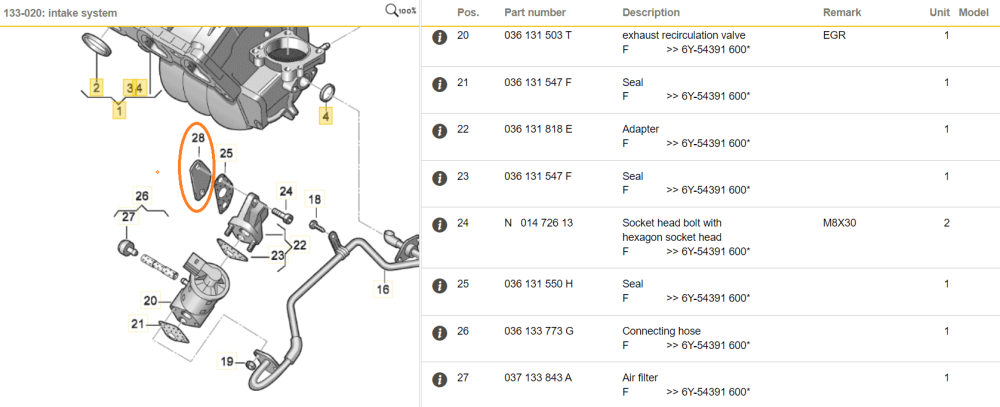
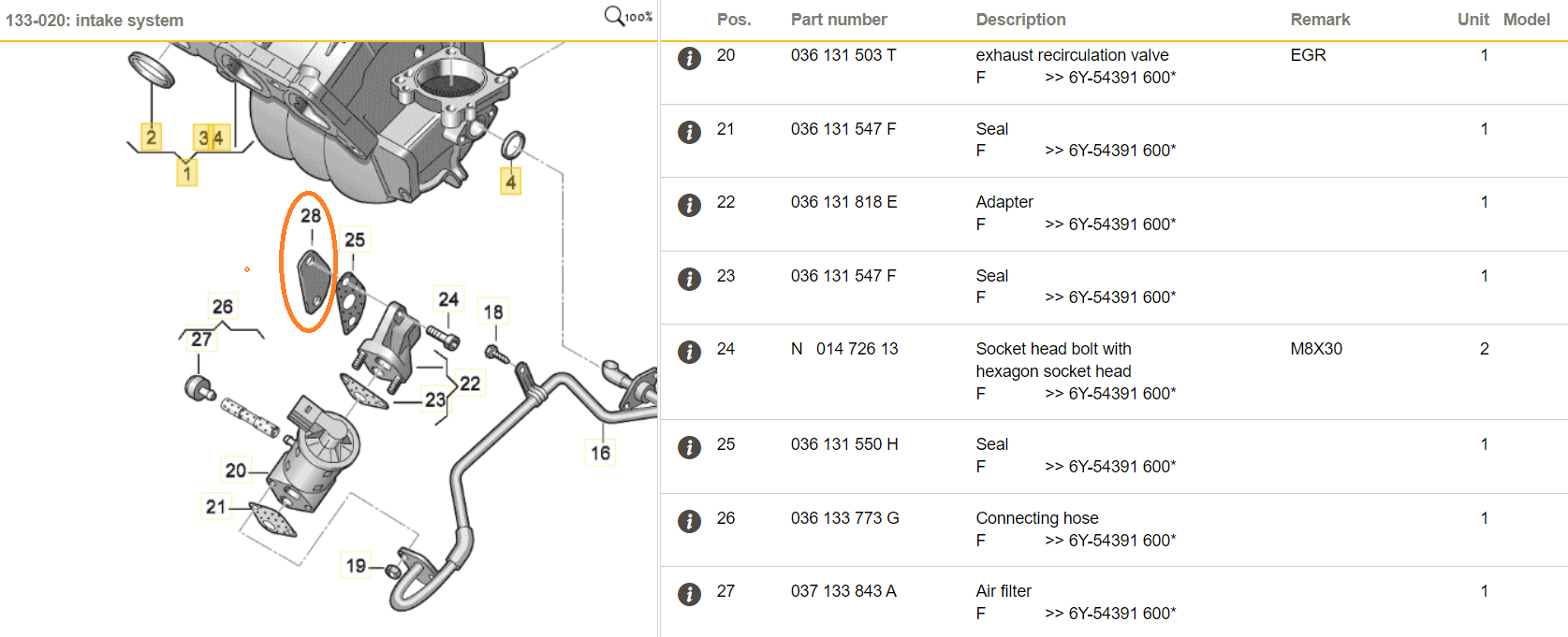
I found that plate on another page, it's 036 131 281, £2.09 + VAT from Skoda dealer. No doubt they'll have to order in, probably from Germany. Probably worth trying in my opinion. Maybe also block the air path into the valve via the air filter item 27 too, for completeness. Site is partslink24, which you have to pay for. LLL parts is a nice (free) alternative currently though, except it doesn't filter by VIN: LLLParts
-
It seems like there was actually a genuine part for a blanking gasket at the head end of the system (item 28 here) but unfortunately the table on the right doesn't have an item 28. Could you make something?
-
Possibly, yes. But as I say, it would be nice to prove it is causing or worsening the problem by completely blocking the gas path into the inlet manifold from it.
-
It's hard to know what to suggest. You've already replaced so much that I wouldn't like to suggest replacing the EGR without good evidence that it was at fault. It would be nice to be able to blank off the pipe at one end or other, to see if anything changes. Throttle body (cooler) end seems the better bet for this but not sure what the best way to do it would be. Just disconnecting the electrics from the valve won't really change much I think, if leakage past the closed valve is the issue.
-
Yes, coding is required. Technically you're coding the car to the new battery though. Nothing in a battery to put information into. If you fitted another AGM battery of the same or very similar Ah capacity, the car will sort itself out soon enough though.
-
Fuse 30 was literally the missing link, apparently.
-
More chance of a lottery jackpot win.Is it a BKY with or without an EGR valve?




Important Information
Welcome to BRISKODA. Please note the following important links Terms of Use. We have a comprehensive Privacy Policy. We have placed cookies on your device to help make this website better. You can adjust your cookie settings, otherwise we'll assume you're okay to continue.