
Everything posted by Breezy_Pete
-
Agreed. It can't be wrong voltage because you have observed 14V when running. Alternator output current is demand-led so it will only ever supply what is needed (as far as it can), and should not overheat even at continuous maximum output, I think.
-
The full set of wiring diagrams for (all types of) Yeti from Nov 2013 is a pdf of 5054 pages. Ctrl-F is excellent at jumping to where you need to be though, as long as you know a suitable search term. What is it that you are trying to find out?
-
The code 8GM on that sticker suggests that the factory original alternator was 70-Amp rated. I would have thought that anything that fitted correctly would work though, unless faulty from new.
-
Those doors must be pretty heavy! As you say, good that no-one was in or near the cars. Hopefully it was just a runaround/workhorse rather than a much loved, much cherished example?
-
Does the battery light come on when you turn on the ignition?
-
A bit of googling earlier suggests that the EA288 software has a 'temperature window' within which the emissions equipment operates fully, and this approach may have been judged as not acceptable within the rules. So I suspect the change is to broaden the range of ambient temperatures within which it operates properly, to whatever is deemed OK by the powers that be. Legal profession will be the main winners I suspect. What does the small print say about what proportion of winnings any claimant will get versus what the lawyers keep? Does it even say?
-
It has come up once or twice on here, the first time it turned out to be because of a missing fuse in the engine bay fusebox. Never heard back from the second poster with the same code. Terminal 30 relay - Skoda Octavia Mk II (2004 - 2013) - BRISKODA See last few posts. No idea if a 2012 Golf will have the same fuse arrangement, but worth a look maybe?
-
Welcome. I went through Hoon, Loon, Goon and eventually figured out that you probably meant to type Soon.
-
Or the instructions that came in your set are wrong...
-
If nothing broke, you'll not have any trouble.
-
Check again that it doesn't say 14 ft-lb, which is about the same as 20Nm.
-
You're welcome, please let us know how it goes.
-
Yeah, the 6q.. parts and 6y... ones aren't interchangeable. Different data bus types.
-
In that case it's the correct part, especially if it was previously in a Mk1 Fabia too. (Quite likely if UK sourced) Does it say Fabia II in your profile just to confuse?
-
What year is the car?
-
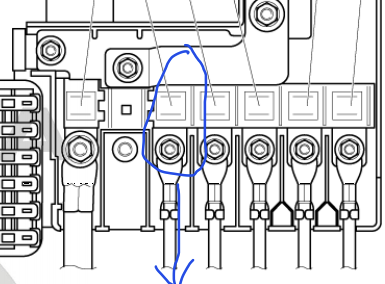
Starter motor isn't fused. That fuse I drew round carries current to many of the things inside the cabin. Described as "Interior voltage supply". 80 Amp rated so whatever is killing it is taking a very large current. Most likely a direct wire short to chassis.
-
Probably this fuse: May be an intermittent wire short from the output cable to ground? Follow the blue arrow to check as much as you can.
-
Now I understand. Use the VW-group part number printed on the relay to search for other cars that may have this type fitted? 1J0906381?
-
There's a version you can download that's similar, but doesn't include the connections via the window motor modules, via this link: MK1 Fabia workshop manuals - SKODA Fabia - BRISKODA Choose Fabia CFD MY 2003... Because you don't have the window motor modules, it may well be exactly what your car has. if you do a search for "F221" once you have the pdf open, it will take you straight to the passenger side lock wiring.
-
Yes, as I said, within the unit I posted the picture of. Removing the footwell air vent gives better visibility (or does on RHD cars anyway). Anyway, unless you do decide to convert to OEM radio remote C/L by changing that unit, there's not much to be gained by accessing it. The relays are soldered into the circuit board. There's a how-to thread in the Fabia Guides section for changing the evaporator temperature sensor which contains photos showing the location of the CCU on RHD cars, maybe even for LHD too. They are mirror image either side of the central dashboard area, I guess. The circuits relating to the locking system are complex; involving the lock module, the window motor module and the central convenience unit. You can download the entire schematics for the whole car via erWin Skoda, after paying a small fee. Some of these have escaped into the public domain but I'm not sure that the one for the latest mk1s (May 2006>) is freely available. What's wrong with the driver's side lock? Just the mechanical key-barrel part or?? I believe there are repair kits for the key barrel available cheaply.
-
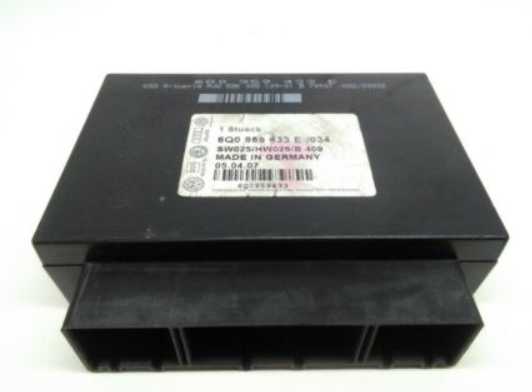
This is the Central Convenience unit:
-
Hmm, not sure the Octavia 2 is necessarily going to work like Fabia 1, but it might. The relays that power the lock motors are within the so-called Central Convenience Control unit, which lives somewhere above the accelerator pedal on Left Hand Drive cars. It is possible to convert key-operated central locking in Mk1 Fabia to radio remote operated central locking, with OEM parts, which may have been a better path to follow. I don't remember if there's a "how-to" guide on this forum, but there's one on Clubpolo.co.uk (9N polo is more or less identical to Mk1 Fabia electrically).
-
Could you link to the system you have fitted, or the post on here where it was discussed? Are the red/blue and blue/purple wires that you have connected into still connected to their original wiring behind the dashboard too?
-
-
Charge the battery up with a battery charger, or try a different battery that reads more like 12.6V when disconnected. At 11.89V yours has almost no power. I'm not sure what you mean by the description of the relay resistance test, what's 'chazz'? The relay coil is between pins marked 85 and 86, so just measure Ohms between those two pins of the relay. Check also that the relay socket in the car has 12V at the position into which pin '85' inserts when the ignition is switched on.