
Breezy_Pete
Sponsor
-
Joined
-
Last visited
Everything posted by Breezy_Pete
-
Can you apply some heat to soften the plastic? What will have happened is that water will have got in between the hole in the aluminium console and the plastic outer, corroding the aluminium which will tighten up on the bush. Cutting them out with hacksaw is a quick and dirty alternative.
-
This all I can offer: LLLParts Not sure why they truncate the first couple of characters off the part numbers, but guess they should be 03. Edit, or maybe not always. Could do with an ETKA expert, are you able to help @varooom? The last one in that list (120A) appears to be 045 903 023A, and seems to fit your engine.
-
Which car/year/engine will you be working with?
-
Ah, I see, yes, just seen the * not valid for vehicles with air conditioning system bit in the WD. Good info.
-
That's not ringing any bells, what page is that on? Ah, maybe J248, the engine ECU on diesels? I think the system that piggoy and I came with up was independent of that, more self-contained, from memory. I'll have another look at the circuits, but I think it's only the diesel engined Fabias that have that wire in the engine bay loom?
-
-
Go for it, please. I ended up fitting a manually controlled system in my Polo, just a couple of rocker switches on the coils of the two relays. Never got round to making it inhibited by the cabin fan being off or any such niceties. Works well though.
-
-
Right hand one of the two marked 53 on bottom row. Left hand one of those 53s on bottom row is your ECU relay.
-
The bit about non-OE batteries not being able to be coded sounds like a blatant lie. Doubt coding would change the situation though. Find a local VCDS owner to do it for you if you want. Quick, easy job I believe, Battery voltage as measured by you, and seemingly confirmed by them does not seem low enough to cause legitimate warnings, I expect there's a minor but irritating fault with the battery management system that they wish to avoid fixing at their cost under warranty.
-
Perhaps the OP can look at the service code on their boot floor sticker?
-
UK market Fabias may not have been supplied on variable service in 2008 root, but other markets probably were. Mk1s could be on variable in other markets. See this ETKA page for year 2000 Fabia for example, first section of table engine oil; for models without extended servicing... - Fabia(FAB) [EUROPA 2000 year] (7zap.com)
-
Always more satisfying to repair rather than replace, in my opinion.
-
Your top photo almost shows the part number I think? towards the top of the image, just a bit too unfocussed to read.
-
Here's the parts list page where it's shown as the last item 1: door handle, exterior - Fabia(FAB) [EUROPA 2006 year] (7zap.com)
-
When I click on that link it says "you bought this item" and I bought it for the missus's 2005 Fabia to swap out while I was replacing the regulator panel earlier this year, so I would say it's just their info about what cars it will fit that's wrong.
-
Yep 3B2837016R Do you mean the wire bit that the black plastic door pin sits on is the only broken bit? I'd be tempted to do without.
-
Crash sensor will be the thing in the door.
-
Worth mentioning perhaps that there's a knack to removing the bonnet release lever that isn't intuitive while in the footwell. I've got some pics somewhere but from memory there's a collar that slides out from behind the lever which frees it. Lower/inner A pillar trim needs this removing before you can extract.
-
Ooh, very recent. That suggests the window regulator mech may have failed on the original panel, and the previous owner fitted a genuine new replacement. Possibly forgetting to re-connect the lock before rivetting it on? That would be a bad feeling. 😆
-
You'd need massive ones if you wanted to use the original holes, if you drill new holes you can use whatever size screws you like.
-
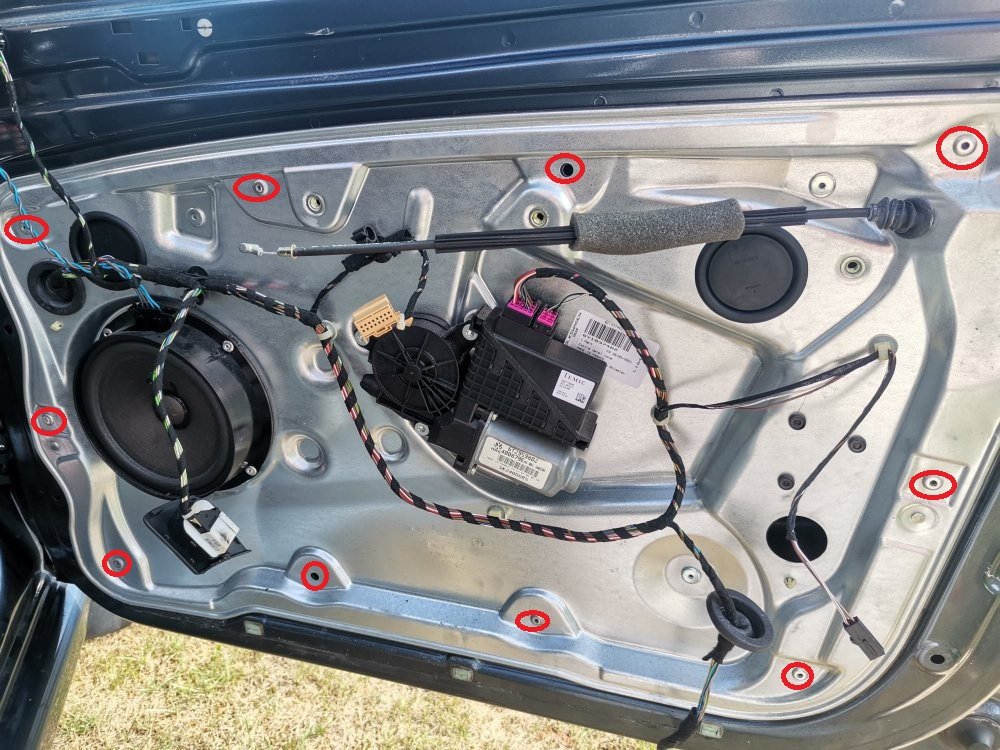
See edit above about date on panel, that may affect decisions about what to replace. These are the ten rivet positions:
-
Rivets are part number N91078801. They are big enough to be beyond the capability of most pliers-style riveters, so lazy-tongs or pneumatic type necessary really. People have been known to use rivnuts to convert to screw-fitting, or even drill holes alongside the original biguns then use self tappers to remount. It's a job to know how much to change while the panel's off, lock? window mech?, especially if rivetting back on. I see you have two rivets missing, on a diagonal either side of the window motor, there are supposed to be ten in total around the perimeter. See if you can see a date on that sticker on the steel panel, just near the window motor, to see if it's as old as the car or not. The missing rivets suggests it has been removed at some point. The panel almost looks a bit too clean to be the factory original?
-
Oh, I see. ☹️
-
Clip on that connector is often broken during removal as it's hard to see and reach, plus people not realising there's a technique to releasing these (push connector on while releasing latch until click is heard, then pull off). May be a case of getting an intact connector and splicing it onto the existing wires.