Leaderboard
-
SteveTheElder
FREEDOM15Points2,471Posts -
mac11irl
FREEDOM13Points16,806Posts -
Stonekeeper
Resident Member12Points2,993Posts -
MikeTheThinker
FREEDOM12Points8,537Posts




Popular Content
Showing content with the highest reputation on 23/08/24 in all areas
-
3 pointsRailways are OK if you live in a town or city, but if you live way out in the sticks with minimal or no bus service the car is your only option. Then there is the cost of using a train. If I drive to Manchester and back it would cost me around £60 in diesel. If I use the train I would have to walk 1 1/2 miles to the station,then a train to Waterloo, tube to the embankment, tube to Victoria, Victoria to Manchester, cost of more than £120 return. I could have 4 people in the car and luggage. On the train the cost would be x4 and luggage would have to be carried from train to tube etc. Railways have their place, but so does the car.3 points
-
3 pointsAs someone who has a degree of involvement in the scheme I disagree - the economics are flawed and, for the money, a large number of other schemes could be progressed that would provide more benefits to the population on both a local, reginal and national scale - be that Public Transport related or not. As you yourself pointed out - pick the right tool for the job...3 points
-
3 pointsNot wishing to cause offence but in my neck of the woods it's invariably the buses that slow all other traffic down with their antics at stops (not wanting to pull in / rivals blocking each other in at the stop etc.). At work we have the analysis from the bus GPS trackers and video and it's quite clear...3 points
-
3 pointsBut still suffers from the drawback that it doesn't take you from where you are to where you need to be when you need to be there at an affordable cost. When I lived in South Molton the nearest mainline station was Tiverton Parkway which was a 40 minute drive away with infrequent buses to get there and parking fess so high that even with a Senior Citizen railcard it was cheaper to drive to London for a weekend visit to family. For mass transit to be a realistic option for many people it needs to provide more frequent services at more affordable prices and be part of an integrated travel network of trains and buses. The severe cutting back of HS2 and the lack of willingness to integrate mass transit systems means that it cannot become a viable alternative to personal transport without a total change in mindset in the UK.3 points
-
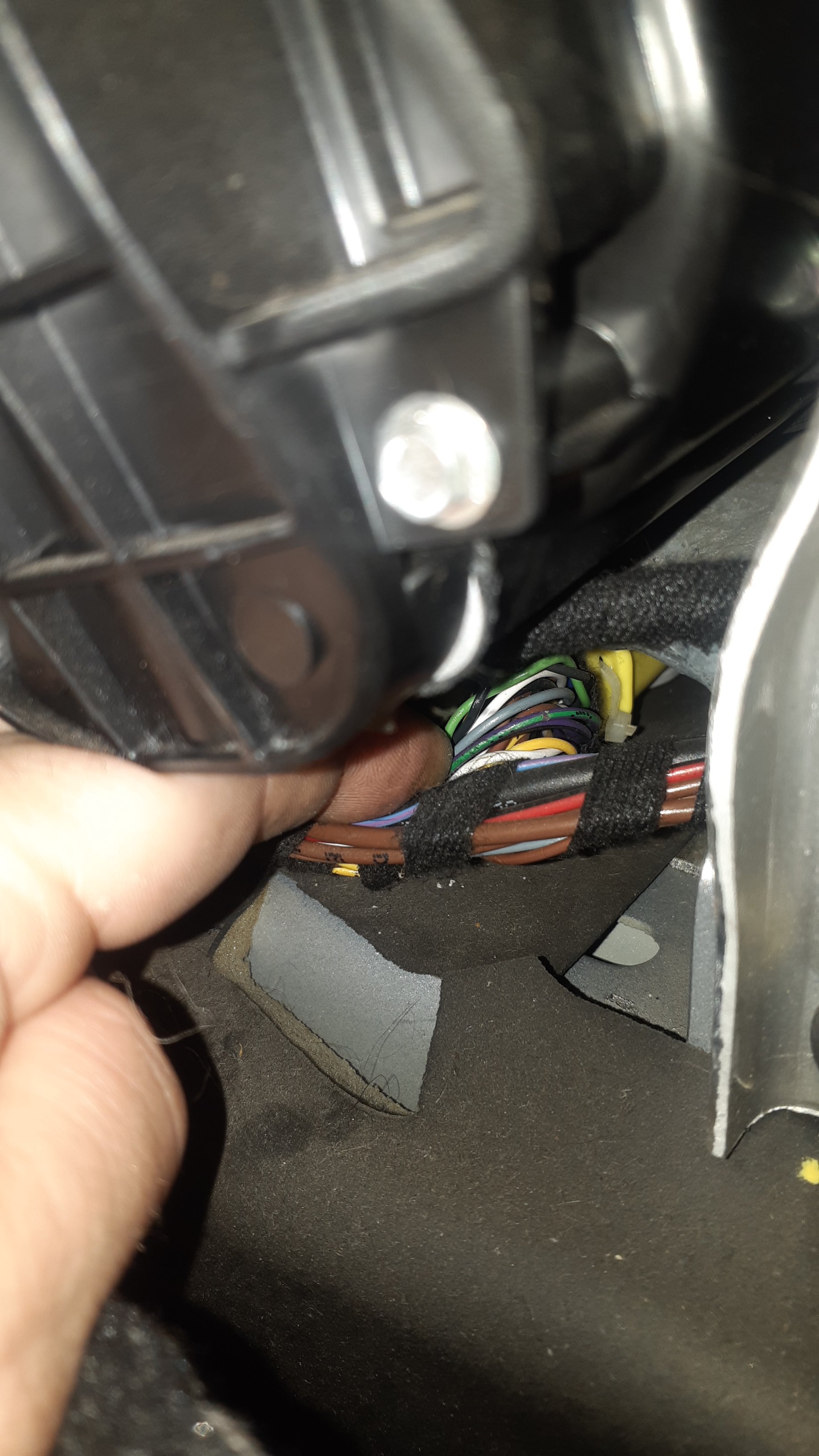
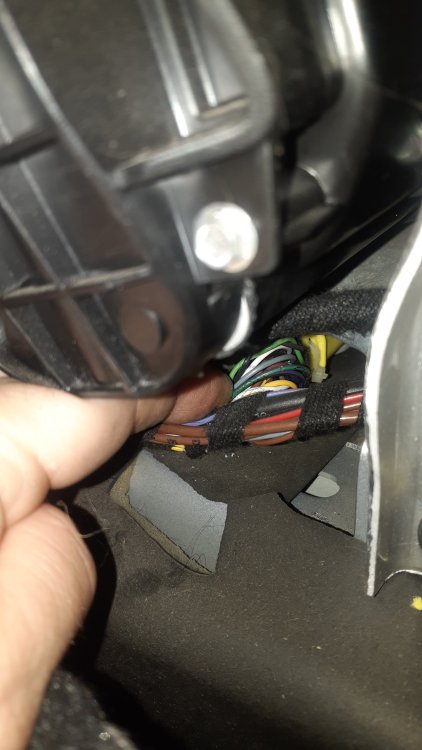
3 pointsHurrah!! Finally found what appears to be the culprit, purple and green from the SRS module to the cutoff switch small chaff in the insulation making ground with parts of the chassis behind the dash.
 3 points
 -
I guess is not hot news, except for a few hotheads? A few links ... https://www.autoexpress.co.uk/skoda/superb/364117/new-skoda-superb-sleeper-edition-packs-porsche-performance-sensible-estate https://www.drive.com.au/news/skoda-builds-the-ultimate-sleeper-superb/ https://www.carscoops.com/2024/08/skodas-one-off-superb-sleeper-edition-is-a-wolf-in-sheeps-clothing-with-470-hp/ https://www.autocar.co.uk/car-news/new-cars/skoda-superb-sleeper-edition-brings-470bhp-and-chassis-overhaul https://www.motoringresearch.com/car-news/skoda-superb-estate-sleeper-edition/ I think in these pages there have been far more 'tuned' vehicles, but is really nice to see effort dedicated to an outgoing model! 🤩 Some sort of Stage II car? Opinions, what you think? A pal from italy mentioned why not slap the 2.5 and DSG from the RS3 instead .... I reply: "not for the czech poor brother of the family, of course" 😁2 points
-
2 pointsThe only way that lecky will get cheaper is with proper regulation or better still take it back into public ownership so any profits remain here in the UK and not foreign banks.2 points
-
2 pointsOn the first point - Probably better given that most of the time the buses had minimal usage due to the unreliability they created in the first place... free flow traffic would be the result with the potential capacity to flow 1860 cars or more an hour through the same point. Allow for the two minutes or so the buses caused an issue and that equates to 62 cars roughly... so probably a balance if the bus was totally full. As for the second - yes it might speed up the said buses but, as has been pointed out - the network outside of London isn't suitable for a large part of the population and even if it was providing a regular (10 minute) service throughout the day on routes that have minimal usage (eg rural ones) would require massive subsidies. I do agree with your point re a change in mindset though - but it needs to encompass all modes and be reflective of need - unfortunately most people are too blinkered one way or the other2 points
-
2 pointsOh yes - I can name a number of locations both local and further afield where traffic lights have been deliberately set to hold back traffic and meter the flow. A prime example being a particular local authority where one of the local Councillors lived on a side road that fed into a major road on the strategic road network. The Council and Councillor had been campaigning for a bypass for years but analysis of the traffic signal specification and timings clearly showed they had been set to give priority to the side road even when no traffic was waiting on it - thus artificially holding back traffic on the SRN, thus creating congestion to back up the request for a bypass. Sorry but that is just wrong on all counts and not uncommon. I've managed the installation of traffic lights that have special 'MOVA' control systems (effectively they self-manage and optimise the signal timings to maximise operational capacity) that have been designed, set and refined on-site whilst live by our staff but, on revisiting to check their operation at a later date as part of the set-up regime we've found that the MOVA control system has been turned off by the Local Authority...2 points
-
2 pointsThat together with the planning going into creating congestion on the roads.2 points
-
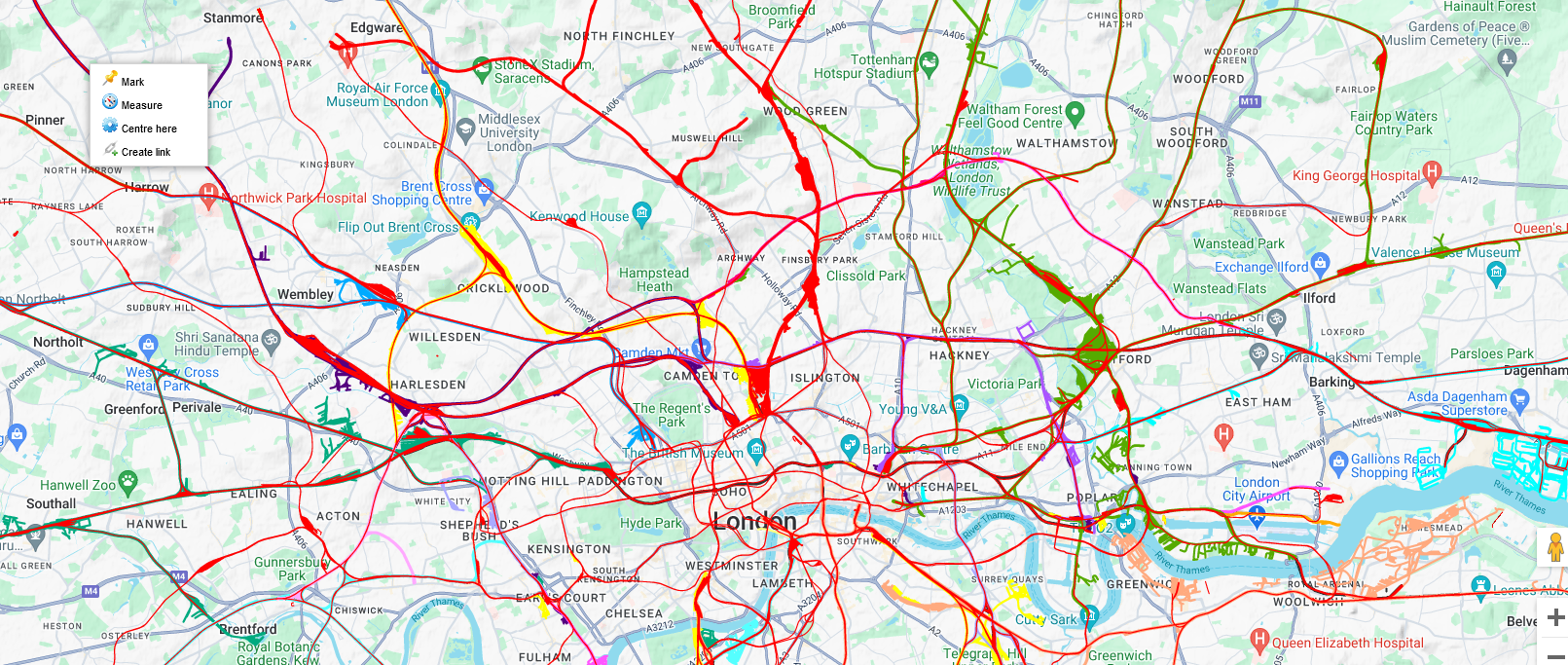
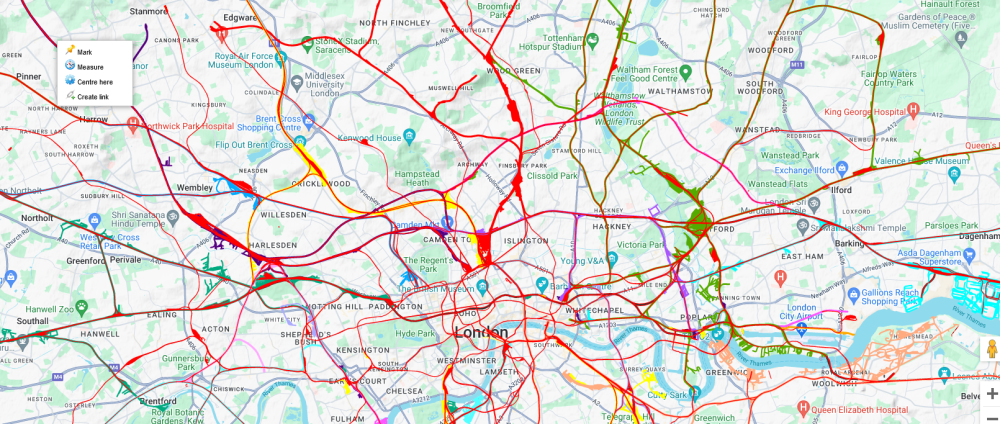
2 pointsWhen the Beeching axe fell i doubt London noticed Coloured lines Historic red today
 2 points
 -
2 pointsThought it would be good to clarify a few things as I see so often on the internet people seemingly speaking with confidence and getting things completely wrong. Wax - originally came in paste, and then developed into spray applications. Natural product, molecules are relatively large so will sit "on" the paint. Supposedly gives a warmer look to the paint but its all subjective and never really noticed it myself. Depending on the product, it can be removed from the paint pretty quickly in awful weather/salty roads. Some products like Autoglym SRP contain fillers so will help fill swirlmarks make paint look corrected (but won't be). Polymer Sealant - development of spray wax to replace the wax with polymer/acrylic to give a hardier coating once its on. Will still sit "on" the paint. Ceramic Spray/Hybrid Ceramic Wax - the Sio2/Silicon Dioxide/Silica version of a spray protection. The Ceramic element is hardier still so will resist and the molecules are smaller than waxes and so there could be an element of filling but that would be minimal. There are a variety of applications, usually spray and wipe and sometimes included as a drying aid (although this is most likely combining the use of water to help spread). Carpro Hydro2 and Gyeon Wetcoat are versions which you mist onto the panel and then jetwash off - the forceful action bonds the product to the surface so very easy to use...but these are sensitive to direct sunlight so not advisable unless classic British weather. These tend to give a more silvery glow to this (I put this down to this basically being the same chemistry as glass); Quick Detailer - you cleaned the car yesterday, it rained today and doesn't look like it has just been cleaned; maybe a bit dusty, or a contaminant in the rain so it has some water spots on it. Enter the quick detailer. Spray and wipe application and most have some sort of gloss effect or light cleaning but there is no one standard minimal set of characteristics so its down to the product. Also often used as a drying aid but any gloss enhancement won't bond for long. **T-Cut Original Restorer - some pre-knowledge for the below. Strong petro-chemical/organic hydrocarbon (Naphthalene I think, subsequently corrected as also including Tetrosyl) that breaks the bonds of the clearcoat (or paint if no clearcoat paintwork) so that it can be massaged and flattened out before it flashes off the the paint/clearcoat reforms its bonds. Its not manually aggressive, it doesn't abrade the paint like a polishing compound would. It can soften edges of deeper scratches. It also acts as a solvent for some contaminants. Ceramic Coatings - these are very very different to anything previous and very specific. These are small concentrated bottles of product that require delicate application so if it doesn't look like that, it isn't a ceramic coating. The ceramic coating is dissolved in very strong petro-chemical solvent carriers like Naphtha, Toluene or Xylene. Again, these melt and break the bonds of the clearcoat/paint, and the ceramic bonds both with the paint molecules and with itself to form a very strong bond. As above, this process can work like T-Cut to flatten out the very lightest of marks on the paint but you're not repeatedly rubbing like you would with T-Cut, its a slow linear movement over the paint so any correction will be minimal if at all. The product then requires an amount of time to fully cure such as 24/48Hrs or up to a few days. Getting the product wet during this time can impact the overall longevity of it. Also, dirt or contaminants caught in the product can be baked-in to last for the length of the coating (some would advise application indoors). Also, the application process needs to ensure there are no "high spots" - product which is built-up and not smoothed out. It becomes obvious because it doesn't allow the light to pass through as clearly and shows itself as a bit of a cloudy patch. It can be solved if caught quickly but decent application avoids these in the first place. Coatings will provide hydrophobic properties and protect the paintwork for anything from 1-9 years. I take anything over 2 years with a pinch of salt and generally unprovable as it is so dependent on how it is maintained and cleaned. It is hardy but is is not bulletproof. You can also create swirlmarks in it, and birdbombs are capable of eating into it if left long enough. It is not immortal. It is also nothing associated with the pencil/MOHS hardness rating - that's essentially a marketing thing. Ceramic Coatings are there to take a bit more of a hit than paint (as paint is so soft and damageable) and assist in UV protection with plenty of gloss and a slick feel. I'm sure there's more but hopefully this helps to clarify. Oh, and when the dealer offers a Ceramic Coating, ask for the product name and look it up. If there is anything to do with a spray, it isn't a ceramic coating; its a ceramic spray.2 points
-
2 points
-
2 pointsI remember as a child going on Holiday to the IOM in the 1960s We went on the Train/foot/ferry the luggage was sent via parcelforce/post office two weeks before and we got it back two weeks after we came home. Those were the days. I was the first in my immediate family to have a car, i know which i prefer.2 points
-
2 points😀 hello all, I’m Neilo, I own a 2010 Octavia VRS diesel, had her nearly 2 years, think she is great 👍2 points
-
All of those people producing tables etc, from official bodies like paid for consultancies by various governments from around the world in the pursuit of getting net-zero, so the pushing of a narrative that electric vehicles is the way to achieve that and hence the big push towards a total ban on the sale of petrol and diesel cars by 2035 and in the UK, a lower date of 2030, are presenting misleading information. I have been stating for some time that I believe we are foolishly chucking everything at the electric utopia theory when it should be considered as an alternative only with a free market choice only. We should be examining other alternatives at the same time, such as reducing engine sizes in both capacity and power outputs, seeing as in most parts of the civilised world it is impossible to use the available power and performance of these big powerful engines. Seeing as this thread is all about fires and as mentioned above, we are being fed duff information, which the critical thinker should have been able to see through all the smoke and mirrors, when they come out with statements and claims that ICE vehicles are many times more likely to catch fire than electric vehicles, therefore EV vehicles are way safer than ICE ones and that I should just accept that as a true fact and that I'm a doom and gloom merchant with extreme bias against electric vehicles. To which I counter that of course there will be more ICE vehicles involved in fires because of their numbers on the road being far greater, coupled with their ages are also considerably older and older vehicles are more prone to failures of all kinds, so that kind of makes perfect sense and I always thought 10 years plus years was when they start the downward decline and becoming more likely to be a fire risk as they lose value and repair costs could be more than the vehicle is worth, so corners tend to get cut. As the vehicles gets even older, their value tends to increase and the vehicles become classics and their owners then can see that the better ones are worth spending money on and restoring them to almost new condition as they become valuable assets. This analysis of fires in parking buildings, carried out in New Zealand, nicely re-enforces the above and was pre EV vehicles, which really helps my theory. It was done from 1995 to 2003 and this link takes you to this report Analysis of vehicle fire statistics in New Zealand parking buildings - CORE Reader and the graph and data on pages 11 and 12 it clearly demonstrates that the number of fires dramatically increases when the vehicles reach 11 to 15 years old and once they get past that age they suddenly start getting to roughly the same as that of newer vehicles, which fits my theory perfectly. Now we currently do not have electric cars of that age on our roads, so when these claims that state electric vehicles have extremely low odds of catching fire when compared to their ICE counterparts, they are NOT comparing apples with apples, instead they are making sure that the net-zero narrative is not being derailed, and hoping that by the time they reach that age, that engineers will have solved fire hazards and mitigated the risks to similar levels of ICE vehicles and that includes the hazmat hazards also being contained to a similar level. I have been saying that the information being put out is flawed, and we are being hoodwinked, and we need to be aware of this ourselves.2 points
-
2 pointsVery easy to service. It is basically lile any other VW mk5/6 with either petrol or diesel engine. I do all servi e and repairs at home. Haldex service is extremely easy, same with dsg as well. Oil, brakes, fluids and all other filters etc is like walk in the park on these cars. Should mention that I have gearbox filler to do dsg service. Vacuum filler for coolant, timing belt locking tool, gearbox jack and engine jack, pressurepump for brake fluid and a scissor lift. Some special tools are required. But ones you have them, I would argue that Skoda is extremely easy to maintain. Use a couple of thousand quid to buy what you need and it is self earned almost immediately after your first major service+timing belt and dualmass flywheel job. And it is fun doing to 😀2 points
-
1 pointThe cynic in me doubts that the people with all the gear and no idea will be capable of or interested in re-aligning the front and quite possibly the rear subframes, they just seem interested in twiddling a few nuts and producing computer print outs. The garage should be capable of putting the subframe back in the same position it was removed either by using the service tools or common sense, I would be very worried that they want you to take it elsewhere. I did not need a Hunter rig to measure and correct the misalignment between my front and rear axles and the vehicle body, just a bit of DIY to attach a laser spirit level to the wheel rims and a cardboard target fitted at the B post and held in place by the closed door.1 point
-
1 pointI would say €329 (definitely Euros) for a LUK DMF from UK I'd expensive at all...Considering most want four figures for one be that LLLParts/Skoda parts websites/TPS etc... It's a very similar price I'd get from Autodocs and from a parts supplier that I trust and know and not have the potential F. Around factor that really isn't worth being inconvenienced by for an extra €21 (Euros) as my time is worth a lot more than that. Autodocs seems to struggle in my part of UK more often than not hence they're on my concerned/wary to do business with. However it others get €10/£20 I'll glady pay more to not be messed around. 😃😃😃 I'm not that broke, just yet, but working to it with Scáthach at the moment 😈😈😈 I still think that my DPF has been blanked, I can't find an emulator in any of the usual places and I really don't believe the part has last nearly 110k miles from factory either...However I have no way of proving yet, if it was to go wrong I'd go down the most sensible way of blanking off/emulating that I could find and my friend Fish does this for his business, so I'd consult with him if the time came. 😃😃😃1 point
-
1 pointYeah as much as we enjoyed fully rebuilding 2 rentals...I ain't pulling the poor classic mini garage roof off and amending it, ready for retiling for anybody, she'll get cold...🤔🤔🤔 That's what independent skoda specialists and other manufacturers garages are for...😍😍😍 🤣🤣🤣🤣🤣 Happy Dan, not having to rebuild anything, Happy entire World 🥳🥳🥳🤩🤩🤩1 point
-
Similarly; particularly I have a tendency to inject Evostik Resin W down screw holes in MDF components.1 point
-
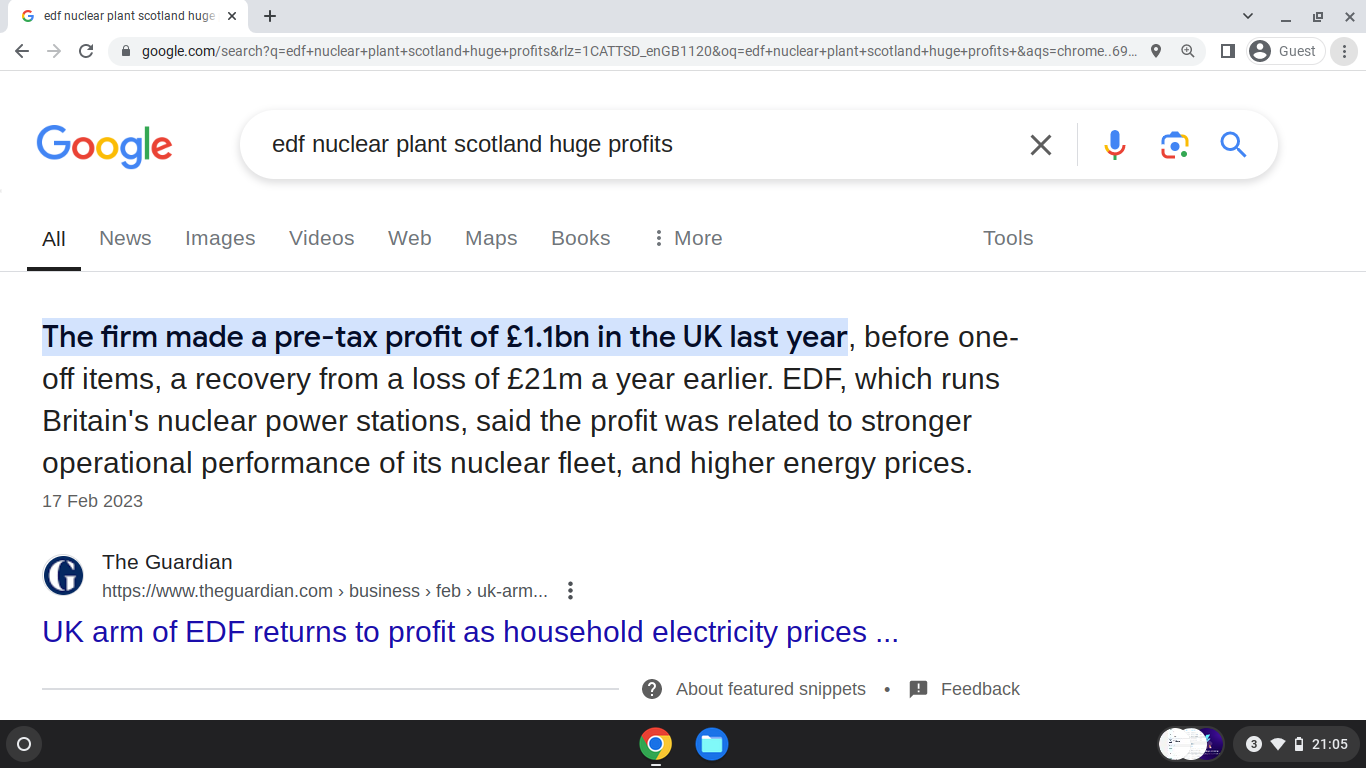
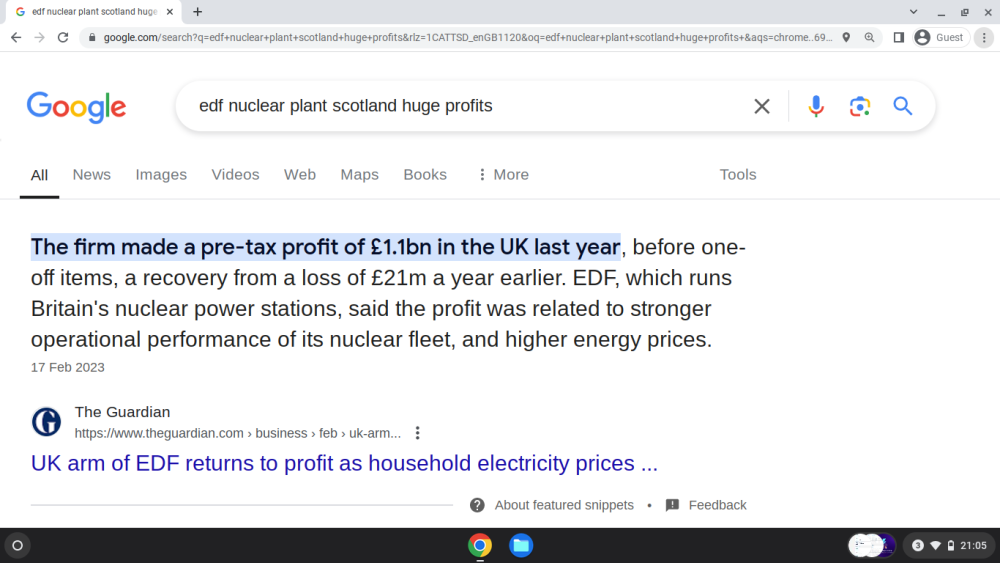
1 point@lol-lol You are having a laugh. The Pylons are still going up from Kintore to Tealing and then south, and the Substation. As to depopulation, well we know which Government has blocked the migrants coming and settling in Scotland. Manipulating Boundries really does not tell the story of a reduced population. The UK Government have no idea how many are in the UK or in England, Scotland, Wales or Northern Ireland or those other Isles that are part of the British Isles, / Channel Islands, IOM. (They do not count them on an count them off. Because that might be embarrassing / difficult to answer for.) Lets not shed a tear for EDF. When the last nuclear power station in Scotland, the only Nuclear power station i hope EDF pay the full clean up costs and not the tax payers or other energy company customers which seems to be the way things work out. (Lots of electricity produced by them in Scotland that was exported for use across the Border.)


 1 point
 -
1 pointNorth Sea, ie Dogger English area, Bristol Channel tidal and Hinkley nuclear should be plenty with more and more home solar pushing down the demand, even with the increasing population. Scottish people depopulating Scotland is an issue, as seen in the reduced number of seats in Westminster as the percentage of people living in Scotland reduces as of the total if the UK. At least the sea route interconnector gets round the pylons issue. If Scotland go independent they could sell the electricity in competition with Denmark, France, Holland and Norway who do such?1 point
-
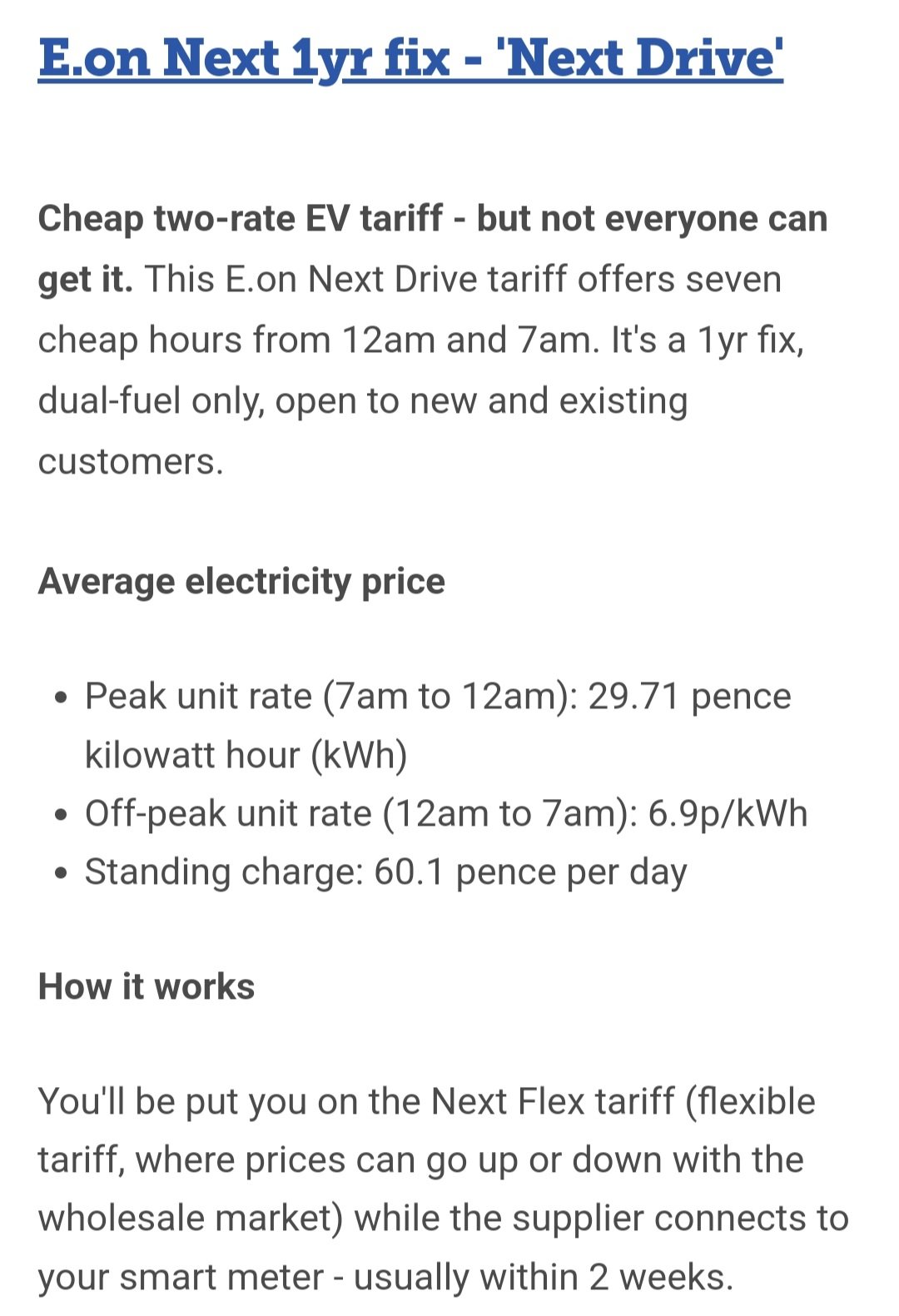
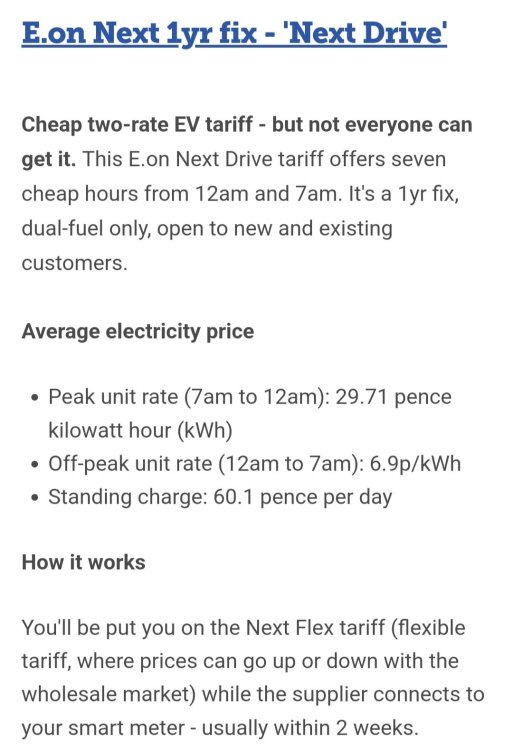
1 pointI looked at the Eon Next Drive tariff today. No way would i get enough of a saving on the overnight EV charging 12-7am to cover the increase of the Daily Chargers and tariff. (Small battery EV.) Not with the tariff i have fixed til next July. PS. A couple or 3 EV,s charging then really a no brainer, or covering the miles to empty the cars battery and overnight charging at home can be win win, especially if very little electricity and gas is being used through the day. Taxi Drivers, Couriers, Business users on a winner, especially those getting paid mileage expenses.1 point
-
1 pointE.on Next offer an EV driver fixed tariff, so I guess that other suppliers do the same.
 1 point
 -
1 pointGreg Jackson spent some time the Rachel Reeves recently. Bold move to take away the winter allowance from everyone and put it through so the money is actually spent on fuel. The cheap ev tariffs are not subsidised but purely a factor of those times of the day when nobody else wants to buy lecky. With more of Dogger bank coming on line and more international interconnectors lecky should get cheaper and cheaper. I would like to see more tidal, zooming around in an HMRC/ Border Force Cutter I can appreciate ho powerful those tidal currents are in between the Scottish Islands and here in the Bristol channel we could generate 5 or 6 GWs much of the time. Hopefully that hydroelectric water storage, 30 Gwh would be awesome.1 point
-
1 pointWell, if u ask any eastern european from low cost counties, they would argue that special tools are overly overrated and TOTALLY unnessecary, heheh. Eyemeasure and hammers do the trick 😆 Lots of videos on youtube 😉 Anyway, correct distance is up till 0,5mm from seal to plate according to vag specs.1 point
-
1 pointI could easily knock up something for the correct alignment of the reluctor ringbut it looks like the issue is getting the correct depth of the oil seal and reluctor ring and them being at 90° to the crankshaft axis because VAG did not fit a stepped counterbore. Good to know, thanks for the info.1 point
-
1 pointMy money is on the ABS exciter - not even an each-way bet, all on the nose, ABS exciter, left rear.1 point
-
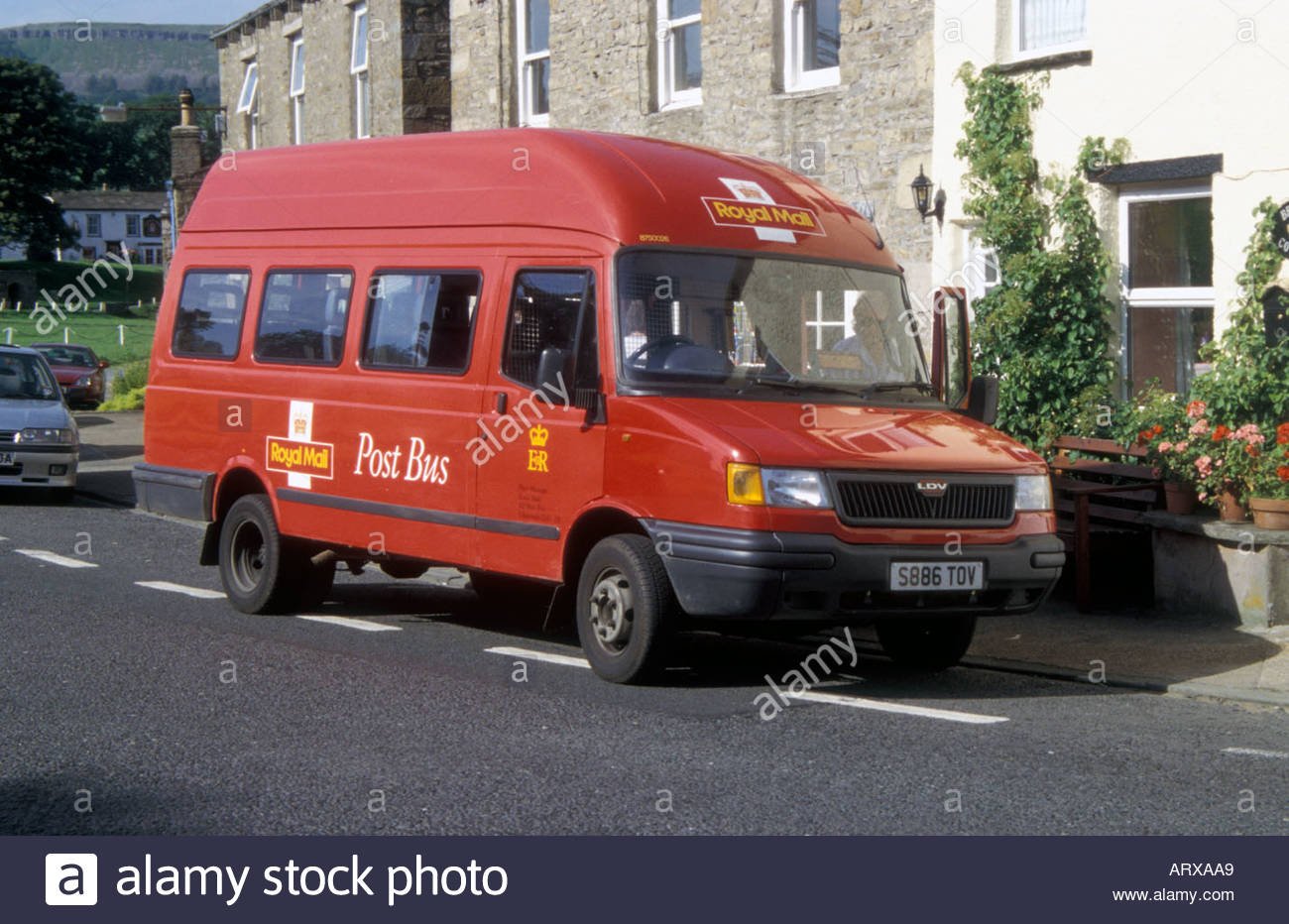
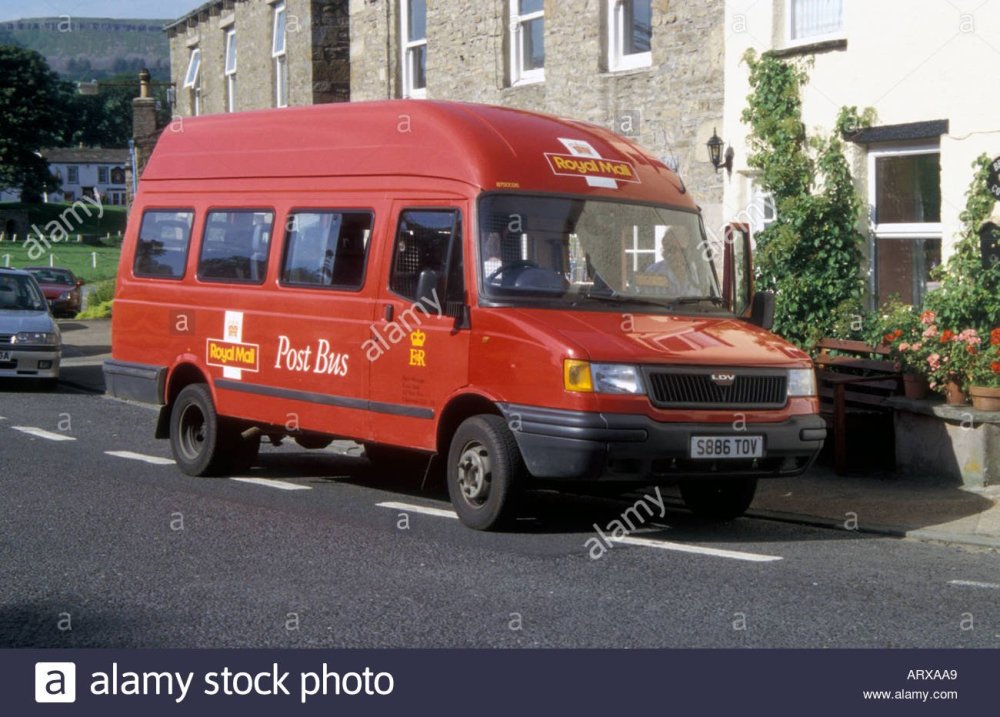
1 pointWell I and a good few other people are going to have to continue to disagree with you. This country and quite a few others around the world all operate on a for-profit basis and if that profit is not there except for certain times of the day, then those services are simply not being offered outside the lucrative times, full stop. Our rail network was destroyed many years ago by the Beeching cuts when large chunks of the infrastructure were removed and disconnected from the system, leaving people living in the areas served by the trains no other options but to either move to a large city (not at all easy or possible for many people) or go and get themselves a car and join the car set. Buses in these areas is also not an option as I know from actually working in that sector when they were nationalised that rural parts of the country would get a limited bus service at certain times of the day, again not ideal, but better than what they get today, with zero bus services. Since they were denationalised it is run as profit centre, no profit, no service. When that happened the publicly owned Royal Mail decided to operate a fleet of mini-buses in the rural areas but was only operating when the post was being either delivered or collected from post boxes or village post offices, the later of which have now largely been axed. The Royal Mail is now a privately owned business focused on profit only, so these services now no longer run. Even in some large towns and cities the bus service is woefully inadequate and offers only a partial solution with large chunks of real estate not being covered and the areas that are covered only operate between certain times and when you get things like flu, or covid etc, then they operate like massive conduits to pass it onto the population in vast numbers because that the only transport available. No I'm sorry, but mass transit systems are not the solution, they are part of a solution if you happen to live in the right area, which London is just about the best connected city in the UK but even then it does leave a lot to be desired. You happen to live in London and I have heard the arguments that you present many times before and almost certainly it is repeated by people like you who live in London and can take a reasonable level of service for granted, those less fortunate cannot see the logic in your thinking. To advocate dropping the car and using mass transit system is like it or not going backwards, a bit like taking away your UHDTV and giving you back in its place an old black and white TV with just 3 programs, BBC1 BBC2 and ITV in 405 lines transmitted via the air and if you again happen to be in the right location, you can get a picture. You would not be happy with that, I'm sure.
 1 point
 -
1 pointI have an OBD11 unit from OBDeleven.com. Beware the the single press functions, I believe they do not all work correctly and don't record the steps in the history.1 point
-
1 pointI seem to remember that the sound actuator was not an option on MIB1 unit. So setting the volume to zero was only possible using OBD11 or VCDS.1 point
-
1 pointIt is possible to set the volume to zero using vcds/obd11. It's worth checking.1 point
-
Hello, This has being discussed multiple times. All the android head units will give you headaches. Most annoying us horrible call quality. Go foe the mib2 upgrade with a wireless android auto dongle and you will be good to go. It is more expensive but worth it. I went through 3 Android units before upgrading to mib21 point
-
1 point
-
1 pointThanks for answering, you made my day. I appreciate you. Edit: If I want to know more, next time I will start my own thread for better conversation.1 point
-
No photos sorry, but it's the connector plug where the loom entered the ecu under the wiper panel. You need to remove the wipers, then the 2 plastic panels then you can see the ecu. 2 weeks now and no problem 😊1 point
-
1 point
-
1 pointSome would say with hindsight, that you nearly guessed the job pricing and times right...🤔🤔🤔🤣🤣🤣 The rear main seal is 1/10th of the cost for the actual labour of doing the job at an Indy VAG Specialist...That says it all. If you're keeping them for a long time then some investment in specialised tools will pay off for themselves in the long run Vs labour charges and VAT costs etc, however I do completely understand that not everyone has the space or the spare capital or even the time to do it in a lot of cases. However a lot of the basic repetitive servicing is very easy to access and do yourself and will save you money and some cases time e.g. by not breaking down etc. On a side note though some of the maintenance schedules are very long on some items in my opinion and have been decreased by myself to shorter intervals, so doing these items myself will save a lot of money...Especially where I go, an oil and oil filter is £179 all in! After parts and taxes, my labour and overhead costs are not that much as an actual business and what they have to pay, so doing them myself is more cost effective if I'm reducing service intervals. I just wish like rbhelle that I had a scissor lift to undertake some of the other jobs I listed above or even a post lift would be the absolute dream, however a pre-fabricated W-Truss roof structure would prevent me from realistically changing this situation and I whilst I have the skills to change and rebuild roofs...I iust don't have the inclination to do so at my property for free! 🤣🤣🤣 I like my wife but not that much!1 point
-
a guy in the Netherlands has done that already - RS3 engine and gearbox in his mk3 Superb. look for him on insta - superb_vrs3 although the engine blew recently, which he is currently in the process of being rebuilt.1 point
-
1 pointI have: Thule Wing Bars. I can vouch that they are very quiet as aerodynamic. Roof box: Kamei Delphin 340 box with - T Track fitting. This allows the box to slide on and off the roof bars really easily as they have a slot down the middle. It's a good sized box with the estate for my family of four. https://www.roofbox.co.uk/roof-boxes/kamei-roof-boxes.php?srsltid=AfmBOoqnDAIC4X0vmgM1TcjMa7-U_kqrTtQxBczWS3X3ZaV2_5qMEg9z1 point
-
Hi all, Hope this is the final update on this journey! Yesterday I received the car from the shop. The AC lost some refrigerator gas and I suspected that was the condenser. It was with a lot of dents from stones, and even wholes, 11 years of intense highways here in Portugal Hi ask the shop to replace the condenser and check the charge air cooler radiator. They checked and propose to change as well the charge air cooler radiator because it was with a lot of small stones as well and because the front of the car was already out, it was the best time to do it. Apparently, problem solved!!!! Now, on high loads, charge air cooler temperature sensor 1 (before charge air cooler) can reach temperatures like 110-120ºC but sensor 2 (after charge air cooler) remains at 44 to 46ºC. On low boost, it keeps between 40º to 42º and we can see on the chart (android app) the pump turning on and off with the temperature dropping and rising. Hope this helps other to solve their problems as well. This issue was never solved by any shop since 2019.... After many €€€€ spend on other sensors and valves and cleaning, it was this community and my searching and interest that solved the problem! Thanks to all!1 point
-
1 pointWell, I wouldn't disagree with you on that one. I checked the repair manual now, and it is quite a job just to replace the oil seal. Engine must be at top dead center, so you will have to use some special tool there as well. Even in my home garage thats has a scissor lift and engine jack, there will be a full days job++ on this one. I just bought the T10134 special tool now from autodoc. Just under 87GBP for it and a new seal from Febi Bilstein I paid 43GBP. Again, your EGR cooler could last another 60-100 000 miles... I guess your engine had only 100 000 miles in it (160000km)? So, it may not be necessary to replace egr cooler just to be sure/preventive. On the other and, when all "****" is down on the floor, at least replace the dual mass flywheel that is almost a certainty that will fail within the next 25-50 000 miles (40-80 000km). To sum up what I pay to do all we have discussed is only premium parts: LuK dual mass flywheel: 252GBP EGR cooler: 130GBP Oil seal: 43GBP Febi Bilstein DSG service kit with 7ltr oil, bolts/gasket rings and filter for dsg: 80GBP Landing a total of approx 500GBP in parts. Planning to use a weekend on the job. Have done this 2 times before, so luckily I know what to do. I am using the electronic Elsawin repairmanual. So, there are a lot of money saved if you do it yourself. Actually, it is not that hard if you have some guidance from a friend or colleague. But, you really do have to have access to a proper carlifter and gearbox jack when we talk about diesel 4x4 dsg. Actually, haven't seen anyone on youtube doing this operation only with floorstands. Think it is a reason for that....1 point
-
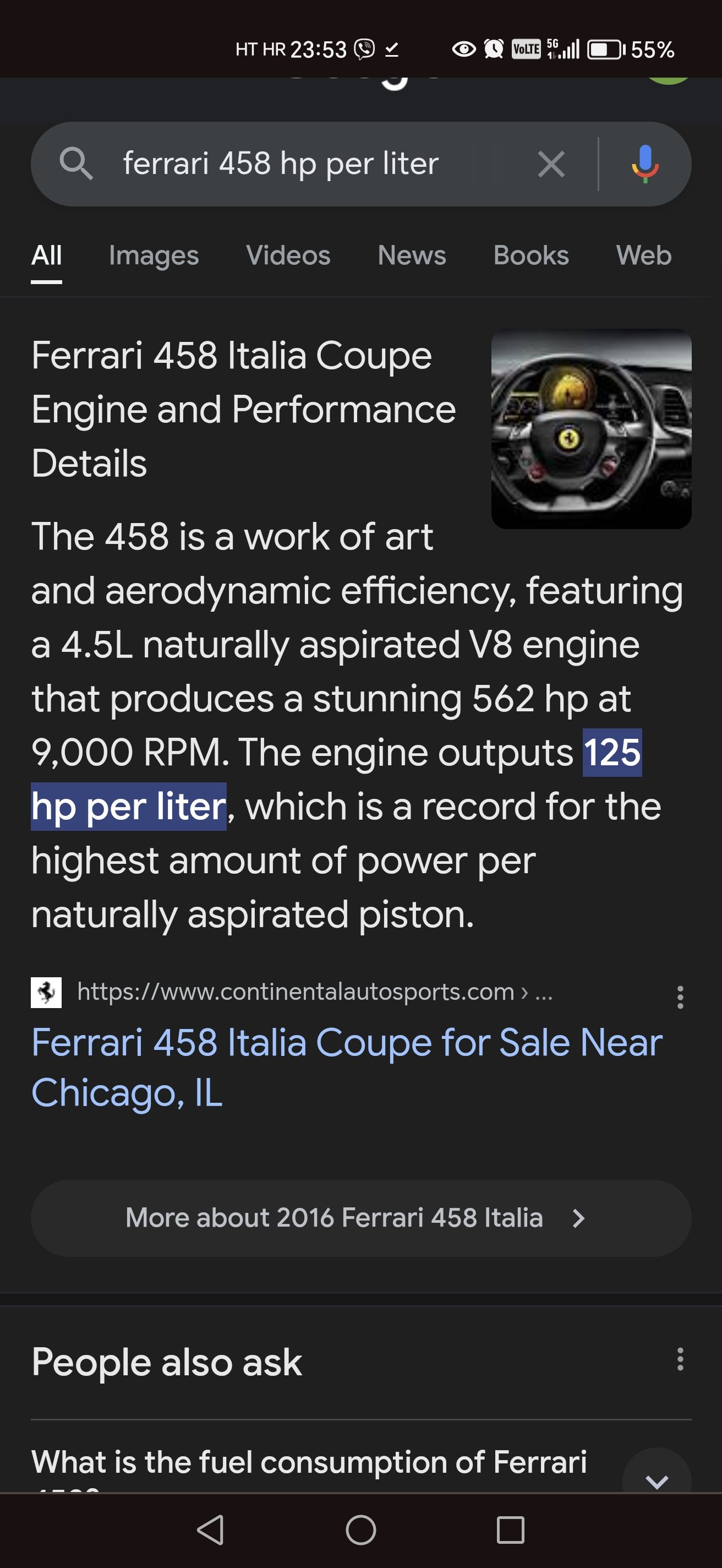
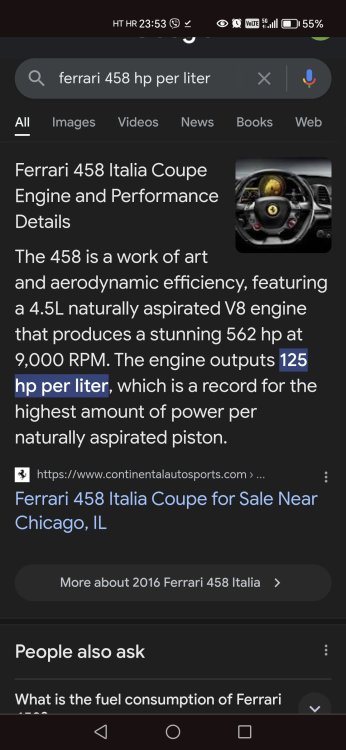
1 pointFirst IT was S2000 with 240hp 2.0l engine, 120hp per liter, than years after it Ferrari 458 with 125hp per liter. We are sure with this build for 250hp and aiming 300hp Mark😇😇 Will keep you updated
 1 point
 -
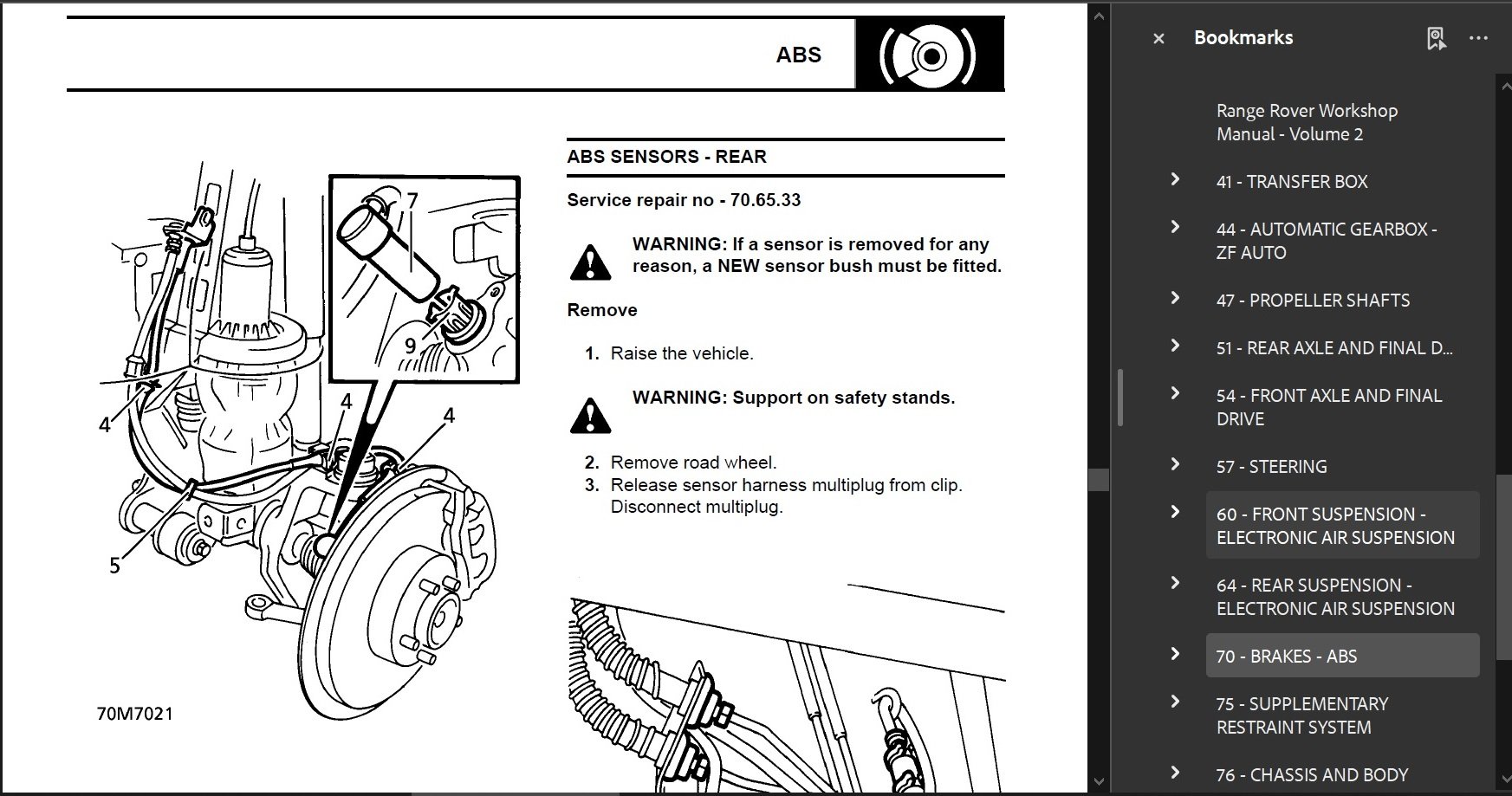
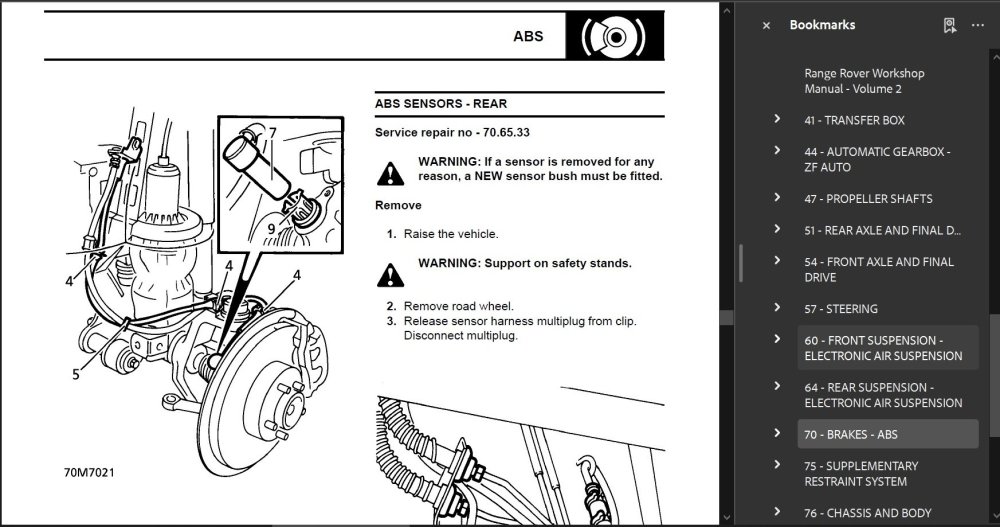
1 pointUh, you are forcing me to admit my guilt, as the one who made the mess with the ABS it was yours truly, with my own two hands ... that is why I describe the action ☺️ Three times I had a go at it, until I got it right (this was the first time I ever did an ABS sensor). I have to say the car is a Range Rover P38, for which perhaps many rules of the automotive world do not apply ... in fact, most of 'em 🤪 Here is the way the ABS sensor comes in its kit, with the bush I was referring to: https://www.roverparts.com/brakes/sensors/STC3385/ Here is the way it looks when installing it from the workshop manual: Anyway, my intention was not to distract from the topic, just to add that sometimes there are things that look to be super straightforward, and instead are not, so the advice was not to rush but go methodically at it. I got the Audi without working A/C, and by exclusion and many attempts I am now down at a wiring/electrical issue. If I had paid attention to the first shop I asked I would have forked out many bills for a new compressor, pressure sensors, and such, but that would have not corrected the issue ... I will retreat now quietly in my hole and perish away 😁
 1 point
 -
1 pointHi Marky, likely a 21 plate PHEV, I'm not looking at a 4th Gen at the moment.1 point
-
1 pointAC compressors are permanent drive and have a shear plate on the front I believe they have 2 styles of plate. you'll probably find the pully is spinning independently too the shaft.1 point
-
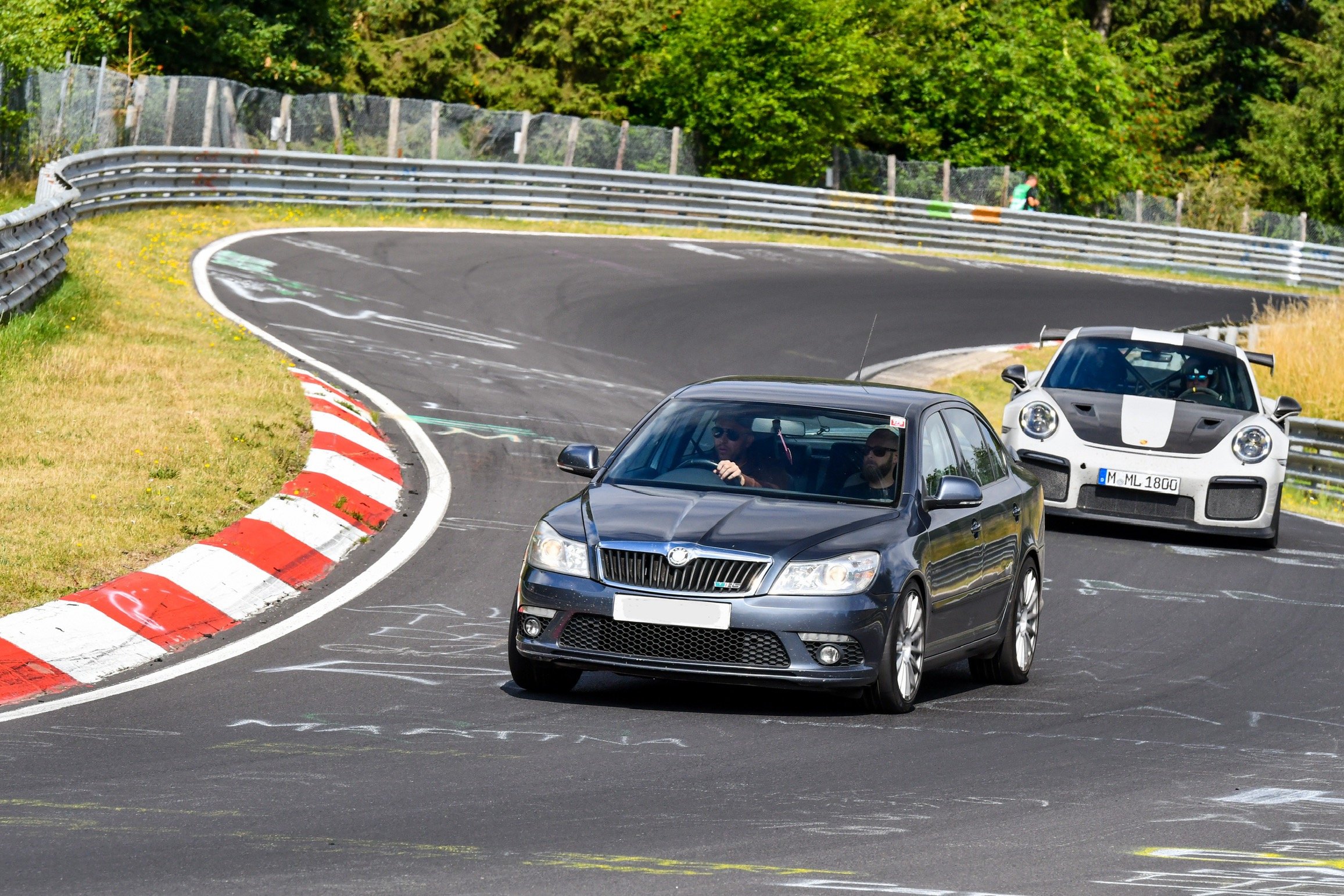
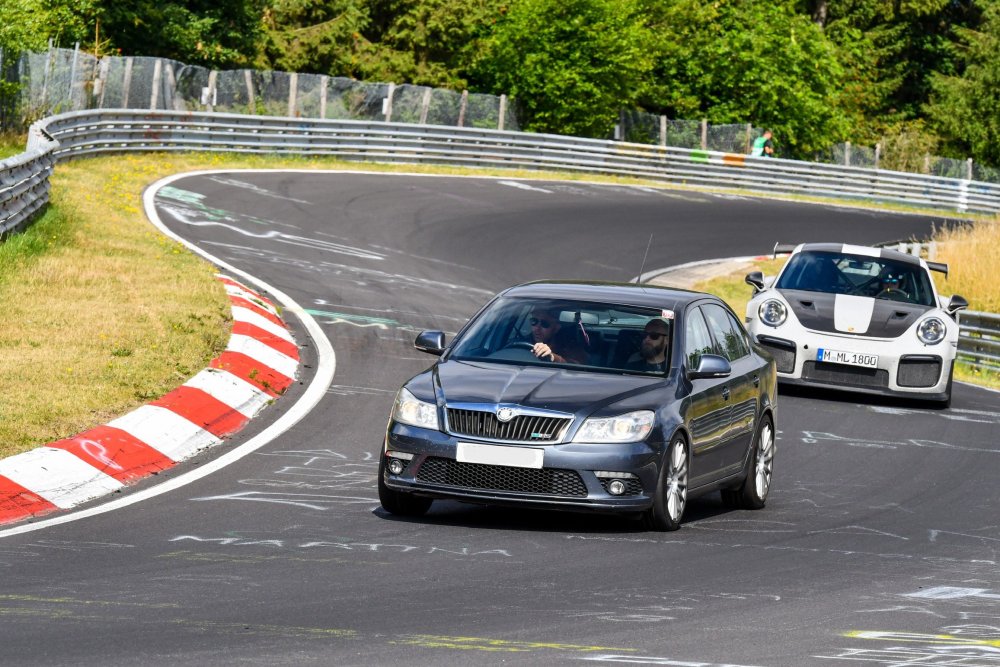
My favourite photo of this car to date 😄 I deffo wasn’t overtaking and gapping that Porsche, although I’ll happily let you think that 🤣🤣🤣
 1 point
 -
1 pointMy tuppence worth: When you are in an accident and it's defo the other party to blame, then you should not be at any loss. If you want to take other things in to consideration such as stress / injury etc then that's where those no win no fee type of companies come in to their own. But be under no illusion, they'll only get involved if there's a guaranteed profit in it for themselves. You ask is the insurance industry legal robbery? It could be if you let it. I think where people go wrong is understanding how the system works. The market value of your car ( i.e. selling it ) is very different from the buying price. If you've caused the accident or rather, if it's a 'fault claim' then you receive what the car is worth, i.e. the market value. If you're not at fault, then the 3rd party should be responsible for adding the seller's profit / overheads to get you back to the position you were in before the accident. It's not YOUR insurer who does that, it's the 3rd party insurer. If you have legal cover, they 'should' be doing that on your behalf. I never take legal cover because thru experience, I find it's their own interests in mind rather than yours, and I've ended up doing the chasing. When my car was wriiten off some years ago ( no fault claim ) and the insurer gave me the market valuation, I simply asked them to find me a car at that price. Easy peasy... no need for ombusman or anything like that, just get them to find a car for you at that price. They ended up asking me to submit several prices and I was given the average. They're claiming that back from the other party so unless it's a ludicrous figure, it's not a problem for them. Regarding hire cars and any additional costs you incur thru no fault of your own, then if you do not have legal cover thru your own insurer, claim that direct from the 3rd party insurer. There's no getting over the inconvenience of it all when something like this happens, but obtaining the right money for your loss and compensation is usually straight forward. You just have to be reasonable and show a willingness to be flexible about it.1 point
-
1 pointOh thats nice. A Scout with a Virtual Dashboard. I want one for my Scout! However - you are looking for the AdBlue settings in the wrong place. It isn't on the centre consule or MIB2 interface - the settings are on the Virtual Dashboard. Using the righthand button on the steering wheel marked with two squares inside each other, you will enter into the various system menus for the car. Select - Vehicle Information. Now using the scroll wheel - scroll around until you find the AdBlue information. The offer of a Zoom meeting to assist is still on the cards if you want it.1 point


.thumb.jpg.f83a46b9b3c0d976b9dbffbb523c9874.jpg)